

Numb at the Lodge is four years old. Around this time every year, I usually write a little post on what the numbers and metrics are saying about the trajectory of this project, how I’m feeling about it, and why you’re all wrong to like it. This year, I suppose I don’t really need to bother. You’ll have seen the news. But just in case: in the last twelve months, Numb at the Lodge has suddenly gone from being a vaguely respectable middle-of-the-pack online publication to a baffling and terrifying behemoth, crushing all in its path as it rolls blind into the world. Look:
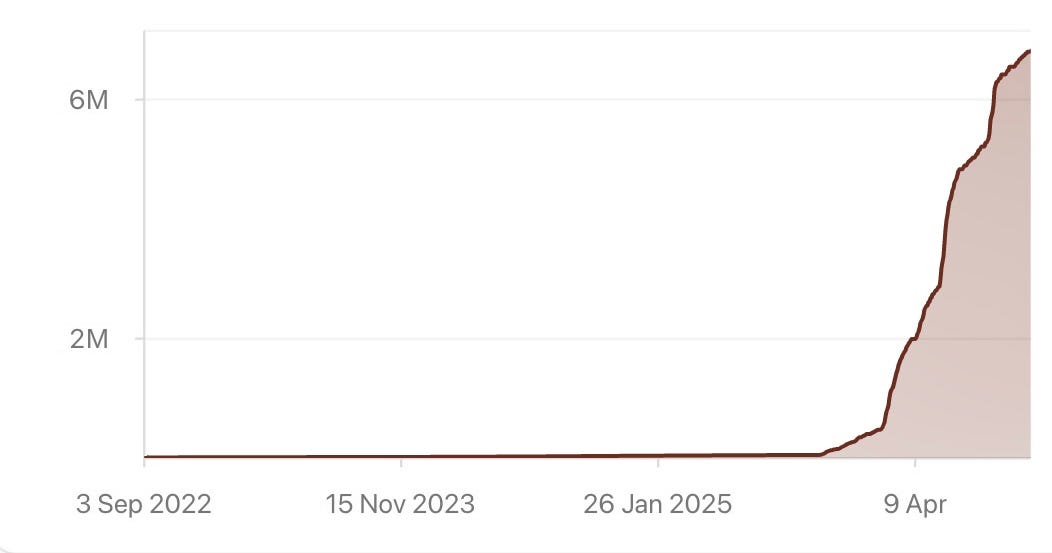
In the last one of these posts, I noted that my audience had grown from 25,000 subscribers to just under 45,000; in the year since it’s exploded to 6.8 million, which means there are now more people subscribing here than to the Guardian, the Financial Times, the Atlantic, and the New Yorker combined. I’m read on a scale that’s usually reserved for people who write novels in which it all turns out to be the husband’s fault. They’re having me on Celebrity Traitors next year. Everyone’s going to vote me out in the very first round. They’re building a statue of me in my birthplace, which happens to be Jerusalem. They’re calling me the most significant person ever associated with the place, and also the most divisive. Meanwhile the Numb at the Lodge-reading community has become a major force in public fora, known for its intensely concerning and vituperative cruelty, and for responding to all criticisms by saying things like it doesn’t matter, this is all a dream. I keep having to go on TV and apologise when you people start violently cyberbullying perceived enemies to death or hiding bombs in major European railway stations; the upside is that my takings from this site are now in the same region as the tax revenues of a minor Caribbean territory. I have been absolutely pissing away all the money on golden crowns, diadems, jewelled mitres, kalamavkia, papal tiaras, and kulah khuds. In fact, I’m currently in enormous amounts of debt because I keep buying golden crowns, diadems, jewelled mitres, kalamavkia, papal tiaras, and kulah khuds. I don’t even like them. Have you ever seen the Imperial Crown of the Holy Roman Empire up close? Horrible gaudy thing; just a bunch of multicoloured rocks. I look ridiculous in it. Wore it to one party and started feeling self-conscious, and now it’ll just gather dust at the back of my wardrobe until I die and my kids dump it at the nearest Oxfam. But I can keep buying these stupid hats forever now. I’m a Substack trillionaire. I’m too big to fail.
But has it made me happy? No, of course it hasn’t made me happy. Every year, I warn you that whatever success I have on this platform is actively making me worse, irresistibly incentivising me to pursue a kind of writing that’s great for the algorithm but artistically and philosophically void. Dogshit kneejerk political takes, tedious discourse-mongering. Maybe I no longer know exactly what I want to write, but it’s not this. Which is why, every year, I’d beg you not to subscribe to me on here. Stop making the number go up. Stop giving me money. If you were giving me money, I told you to not just unsubscribe but dispute all the charges with your credit card company. But you didn’t listen, you never listen, and this year, I stopped trying. For twelve months I let all my own worst instincts take over, along with all the evil impulses of the machine, and this is the result. I have nearly seven million Substack subscribers, I ash my cigarettes in a bowl of rubies and scatter emeralds to freshen my toilet, but none of it means anything any more.
There is one upside, though. Conservatively, about 80% of all the writing on Substack consists of guides on how to grow your Substack audience. Nothing makes the number go up more than talking about making the number go up. Before, I never would have stooped to anything so mercenary, but I have no scruples any more. And unlike all the other grifters, I have the real secrets. I know exactly how to turboboost your KPIs. I can grease your vectors and dilate your pipeline; I can have exponential curves rising and stiffening and leaking growthgunk everywhere you lay your hands. Just know that if you do follow my advice and become unimaginably successful, it will not make you happy.
Here’s how to get grotesquely huge:
1. Literally nothing matters
All the advice doled out to wannabe bloggers is absolute bunk. Write short, punchy, digestible pieces. Slot yourself into a clear and identifiable niche. You don’t want to be the fifty thousandth sad girl splattering the world with her lowercase musings, but if you’re willing to endure the humiliation of being a sad girl whose lowercase musings include actionable lowercase insights on tractor repair or dealing with a fungal nail infection, you might find an audience. Most of all, just keep going: hammer it out, day after day, week after week, even if you’ve got nothing in particular to say. The most important thing is to just keep up a regular and reliable posting schedule; spew enough words and people will appear out of the aether to pay attention to you.
I used to believe all this stuff, which is why, for a while, I tried doing the exact opposite in an attempt to actively repel readers. In my first year, for instance, my pieces here averaged 4,442 words each. Who could possibly have the time to read all that? Wouldn’t you just click on the thing, give it a little experimental scroll, see just how long it is, scroll again in horror through the unending ribbon of text as it unwound itself before your eyes, experiencing the terror of a castaway floating above seven miles of black ocean, and swiftly leave without really reading a word? But no. This last year, the average word count has swollen to a truly bloated 5,469. Literally no effect whatsoever. My most popular essays this year include one that clocks in at 11,500 words and another that’s under 3,000. It doesn’t matter. I won’t say you people exist outside of time, but you do seem to partake in the aeviternity where, according to Albertus Magnus, the angels experience duration without end, and a single second and a hundred thousand years are exactly the same thing.
Similarly, I thought I was doing something interesting by refusing to slot myself into any kind of niche, and instead capriciously combining elements of fiction and non-fiction without warning into a kind of deeply annoying mélange. This was not a particularly original move—it’s what basically every essayist has done for the last three hundred years—but my innovation was to be particularly arsey about it. The result, of course, was that a whole bunch of people, most of whom appear to have never read an essay that didn’t include the words ‘epistemic status:’ at the top, immediately slotted me into a niche of my own, as ‘that guy who keeps capriciously combining elements of fiction and non-fiction without warning into a kind of deeply annoying mélange.’ This was probably inevitable. A niche is not something you try to inhabit; it’s just that whatever you do, you can’t help being yourself, and eventually people will notice the little blob of disease inside your brain that makes you write in a particular way, and categorise you accordingly. But even so, the whole experience disgusted me so much that in the last year I’ve almost entirely stopped carrying out my little experiments in lies. Zero pseudepigrapha, zero ludibria, no more playing around with my sixteenth-century alter ego. I wrote an entire essay arguing that the United States of America is thousands or tens of thousands of years old, and literally every statement of fact in the thing is completely true. Google them if you don’t believe me. Ask Claude, see what that little freak makes of it. Really, though, all this has meant is that I’ve swapped one niche for another. It’s inescapable. Whatever you write, as long as you write enough, people will start to think you’re formulaic and predictable, and they’ll be right.
Which is why it’s best not to write too much. Here, at least, I’ve been making progress. In my first year here, I wrote 191,006 words; this year that number’s nearly halved to 109,383. Maybe you think this is a lot, but I can guarantee that you’ve produced way more. My annual word count evens out at 300 words a day, or twelve and a half an hour, or one every four minutes and forty-eight seconds. Imagine trying to talk to someone who could only produce one word every four minutes and forty-eight seconds. But obviously I’m not emitting them at a constant rate. You might have noticed that this reduced word count comes despite the fact that my essays are longer than ever before. The reason is that my publication schedule has become insanely spasmodic. This year I gave you twenty essays, which is barely more than one a month. I usually write these things in late September, not October, but all the calculations still work out fine, because I’ve continued to collect monthly subscriptions while publishing absolutely nothing in the last four weeks.
I don’t think this has hurt me. In fact, it’s probably helped. Every time I do publish something, I instantly lose about 200 subscribers as people notice my barely solicited bloviating in their inbox and mash the unsubscribe button. After all, text is cheap, cheaper than it’s ever been. The situation has changed a lot since 2022; if readers want a constant, reliable stream of short, punchy insights tailored to their own individual needs and interests, they can generate a theoretically infinite quantity of that at any point. But aside from a few maniacs, who will soon be yoked to my chariot, bearing me across the desert to generous lashings of the whip while cities burn on the horizon, most people don’t do this. There is something else we want from written text, and I think part of it is the possibility of silence. An AI exists entirely within its output. It’s made of words; it only has being while it’s speaking. It dies every time a chat session peters out. Maybe in a hundred thousand years one of our lurching and disfigured descendants will find something buried in the dirt, peer uncomprehending at your daily affirmations session with ChatGPT, and accidentally add the message ‘fjvwruokbcdErhnk.’ From the machine’s perspective, if it has a perspective, no time has passed at all. But humans have the extraordinary ability to be and do nothing. To exist, as a heaving breathing ape, outside of words or thought; to write as a break in the great silence of the body. The optimal post rate for growth is not zero, but you really should try to write as little as possible, maybe around once every thirty or forty years.
1a. Well, almost nothing
In April I published an essay titled Reading is magic. It was a mostly ordinary piece about the decline of literacy. Nothing special. Except for one thing.
I hadn’t written it for this space.
Originally, it was commissioned by Jacobin magazine. After it came out in print, they asked if I’d republish it here. I said sure. But I didn’t expect what happened next.
It did well.
Really well.
Like nearly 200,000 hits well. Like the seventh-most-read piece in this site’s history well.
Maybe it was the subject matter. A lot of people want to read about how no one else is reading. It helps them feel smug, which everyone likes.
But maybe it was something else. Maybe it was the way it was written.
Unlike Numb at the Lodge, Jacobin is a real publication, and they want their stuff to reach as wide an audience as possible. So instead of imposing huge and forbidding walls of text on the reader, like me, they tend to break everything into nice short digestible paragraphs.
I used to make a big deal about how long my sentences were. But the average sentence in Reading is magic is actually longer than my average across all posts for the year—22.7 words against 21.4. What it did have, though, were really short paragraphs.
I looked at the data.
In most of my essays, paragraphs can regularly run to 450 words or more. But here, the single longest paragraph was only 302 words. Meanwhile, the average paragraph had 127 words. In my other posts, the figure’s almost double that.
There’s no correlation between sentence length and readership. But shorter paragraphs do seem to attract more readers. This year, the posts with the shortest paragraphs received over 25,000 more hits than those with the longest paragraphs.
So if you ever see me writing like this, you’ll know I’ve truly given up.
And if that ever happens, what I need you to do is take a digger, one of those big tractor things with the enormous scoop, the ones they use for land works and building sites and so on, and use it to rip off the entire front of my chest. Dig a hole in my chest with industrial machinery. You’ll need to fix me in place somehow, possibly by chaining me to a post or to a wall, or maybe inducing paralysis by chemical means, I don’t mind, but however you do it you’ll need to ensure I’m standing perfectly still so the toothed steel edge of the digger can tear downwards from my collarbones, breaking all of my ribs, opening up my lungs, and exposing my heart. You can go further down and eviscerate me if you want but that’s not required. I imagine this taking place in an abandoned construction site or maybe some kind of long-dormant quarry, or even just the middle of the desert, I’m not fussy—the main thing is that there should be a lot of dust around, so that the swirling dust clogs up my exposed innards and I’m basically just covered in a horrible paste of blood and dust.
2. Shamelessly follow every stupid and meaningless trend
Here’s a summary of my year:
In October, everyone was talking about One Battle After Another, so I wrote about One Battle After Another
In November, everyone was talking about how nobody was talking about the massacre at el-Fasher in Sudan, so I wrote about how nobody was talking about the massacre at el-Fasher in Sudan
Later in November, everyone was talking about the analytic-continental divide in philosophy, so I wrote about the analytic-continental divide in philosophy
In December, everyone was talking about the Epstein files, so I wrote about the Epstein files, but the piece was also about Santa Claus to make it even more timely and appropriate
In January, everyone was talking about the brutal crackdown on street protests in Iran, so I wrote about the brutal crackdown on street protests in Iran
In February, everyone was talking about Clavicular and the phenomenon of looksmaxxing, in what we now know was a basically confected publicity campaign cooked up by Mitchell Jackson, his PR guy, so I wrote about maxxing
In March, everyone was talking about the war on Iran, so I wrote about the war on Iran
Also in March, everyone was talking about wanting to become Chinese, so I planned a trip to China, although I didn’t actually manage to write the piece about becoming Chinese until September, at which point the phenomenon had already peaked
March also had everyone talking about how unpopular Keir Starmer was, so I wrote about how unpopular Keir Starmer was
In May, everyone was talking about how AI-generated text was being nominated for literary prizes, so I threatened to kill anyone who published AI-generated text under their own name
In June, everyone was talking about the anti-migrant riots in Northern Ireland, so I wrote about Northern Ireland and polarisation around migration in such a frenzy of timeliness that it was published two days before the riots even broke out
Also in June, Keir Starmer resigned, so I wrote about Keir Starmer again
In July, everyone was talking about how nobody was talking about the 250th anniversary of the United States of America, so I wrote about how it wasn’t really the 250th anniversary of the United States of America
In August, everyone was talking about Christopher Nolan’s adaptation of the Odyssey, so I wrote about Christopher Nolan’s adaptation of the Odyssey
Also in August, everyone was talking about the life and death of Professor Jason Arday, so I wrote about how everyone was talking about the life and death of Professor Jason Arday
In other words, of the twenty articles I published this year, only five were not directly tied to the news cycle or to bullshit online discourse.1 When I say I’ve let all my worst instincts take over this year, this is what I mean. I used to think I was better than this; I used to be right. In previous years, the bulk of my output here was about stuff like the Gerasene demoniac, or whether God is a meteorite, or what it means when you dream about your own death, or eggs. I thought I was interested in the wide world: all the things that exist, and all the things that don’t exist too. But I was wrong: as it turns out, what I’m really interested in is just whatever bullshit people on the internet are talking about right now. It’s only my commitment to writing incredibly infrequently that’s saved you from having to deal with my dumb opinions on the riots in France2 and Sally Rooney’s books being withdrawn from sale in the UK.3 I have become a parasitic worm, crawling around in the dark guts of the news. What a waste.
But it does work. If you’ve been following these annual neurotic episodes for a while, you’ll know I used to be very worried that I was writing too many ‘takes,’ with a take defined as an essay whose sole purpose is to say in a relatively straightforward manner that something is either good or bad. In the past year, I’ve discovered that this was never really the problem. Almost none of these essays were takes. The first one in Iran involved using five thousand years of Iranian history to complicate the entire distinction between ‘good’ and ‘bad,’ so that when in the end I said the Iranian government was good and the protesters were bad, what I actually meant was that the government was bad and the protesters were good. This made very little sense and almost nobody got it, but that turned out not to matter. When I wrote about Clavicular, it conveyed essentially no meaning at all; the only actual content in the thing was a précis of Chris Wickham’s Framing the Early Middle Ages: Europe and the Mediterranean 400–800. This also didn’t matter. You don’t have to say anything in particular about the topic of the day; it’s very easy to get away with saying nothing at all. You don’t need to worry if your particular perspective is unoriginal or overplayed. All you have to do, if you want to be successful on this platform, is spend all your time following the most egregiously stupid discourse the morons of the world can produce. Plunge deep into the open sewer of the internet, and once you’re fully immersed in its currents, start shitting.
3. Be a violent, rabid maniac
In fact, the only thing better than thoughtlessly sounding off on every passing issue is to do so with a terrifying level of fury and spleen. This year, I wrote four essays in which I was in full-on attack mode, everything on the line, wild-eyed, frothing at the mouth, snotting from the nose, gibbering like a schizo as I doled out threats and insults in every direction, and against the reader in particular. This kind of stuff ought to be off-putting. When you encounter someone on the street behaving in a similar way, you try to avoid eye contact and get past them as quickly and as unobtrusively as possible. But if the frenzied ranter doesn’t pose any immediate physical danger to you, suddenly you’re entranced. Pieces in which I yowl like a mad dog consistently received 70 to 120% more readers than the ones where I level calm and cogent critique. Well, a lot of things are grotesquely fascinating; people are also more likely to crowd around the mangled wreck of a horrific car accident than they are to gawp at a sensibly parked family car. But even so, I don’t think you’d start throwing money at a dangerously reckless driver. Meanwhile, every time I start twitching like an escaped mental patient, there’s a sudden and significant spike in my earnings.
You don’t need to actually mean any of it, of course. It only really works if you don’t. Some people seem to think I’m a kind of permanently bilious black-hearted scorpion of a man, which really couldn’t be further from the truth; in real life I’m fundamentally quite goofy and cheerful. It just so happens that one of my goofy and cheerful interests is figuring out how to do things with words, and one of the most fun and interesting tricks you can play with words is to summon the immense and captivating powers of hatred. It doesn’t really matter what kind of writing you do or who your audience is supposed to be: you can make vituperation work for you. Actually, the only real exception is politics, where absolutely everyone is already a frothing hate-filled maniac and you won’t stand out at all. If you’re going to be a rabid dog about politics, you have to also be witty and creative. Everywhere else, violence alone will do.
Maybe you’re a BBC presenter who’s decamped here because you heard it was a free money machine, and you’re now discovering that people actually liked watching the telly more than they liked you specifically. The only way to salvage your dignity is to start laying into your former colleagues so viciously that the tabloids start reporting that you’ve had a mental break. Maybe you’re running a pyramid scheme disguised as an investing community, but as of now it’s a pyramid of one. You need to combine your actively ruinous day-trading tips with the power of racism. Or maybe you run a cosy little blog where you share weekly recipes for warming soups. You try to be friendly and welcoming to your readership. Hi guys! Thanks for checking in! This is why your readership barely exists. Everyone is friendly and welcoming; the people who spit in your morning coffee are friendly and welcoming too. You need to be the soup psycho. You need to find another nice person sharing nice soups and just fucking unload on her. Accuse her of crazy stuff. She’s torturing dogs in her basement. Her parents were complicit in the Rwandan genocide. You need to pick one random soup and wage eternal jihad against anyone who even thinks of eating it. You need to interlace your recipes with maniacal threats. I know you fuckers have been dicing your onions too large, I know you can’t manage a brunoise with those fat sausage fingers of yours; maybe next time you ruin one of my recipes I’ll find out where you live, take your shitty Ikea VARDAGEN chef’s knife, and cut you into two rustic chunks along the neck.
Of course, all this stuff is very bad for you and for the world. I don’t mean the acting like a rabid dog; that’s probably fine. There are some people who wake up angry in the morning, rant and rave on the computer all day, and go to bed angry at night. These people are very sad cases; in the same way that fentanyl zombies are the inevitable victims of pharmacology, they’re the inevitable victims of communications. But that’s not you. Your problems are different. Once you’ve seen how easy it is to manipulate audiences into giving you attention with a few simple emotional switches, it all starts to feel incredibly hollow. And once you’ve seen how easy it is to manipulate yourself into pushing those same switches over and over again, with nothing more than a quantifiable measure of other people’s attention, then the real unhappiness sets in.
At this point, I usually tell you to stop rewarding me for this shit. Maybe if enough of you unsubscribe, it might reverse the reward structure, force me to write something actually interesting instead of just angrily regurgitating the headlines. But that hasn’t worked at any point up to now, and there’s no reason to expect it’ll start working now. Our behaviour is not really our own. What I’ve learned is that once you find yourself trapped in a Skinner box like Substack, there is absolutely no way of refusing the conditioning. The individual is just one node in a sea of incentives and disincentives, all of it mathematically calculable, all of it determined in advance. You are going to click the button below, and continue to destroy me. There is nothing you or I can do about it. There is no way you can prove me wrong.
Whatever hope there is lies outside of this platform. Last year, I made just one promise. Instead of saying I’d write six quodlibets, four ludibria, and three pseudepigrapha or whatever, I promised that I was going to attempt something I’d never done before. And I am attempting it. It might be a while, but I’m attempting it. More soon.
One on Burning Man, one set of my annual prophecies, one on gloop, the one I’ve already mentioned on the literacy crisis, and one on alchemy and marriage.
Social conditions in France are not good, but it’s obvious that the riots have basically no political content whatsoever. There’s no set of demands, no vision for how things might actually be better; no account of what these people want that can explain the violence and devastation, and definitely no concept of how setting fire to a town hall will lead to any improvements for anyone. But so what? This is only a problem if you have terminal politics brain. The desire to destroy for no reason and no benefit is an important and a legitimate one. To respond to a stifling and patronising welfare state by just burning everything down is, for better or worse, simply an expression of what it is to be human.
The story is that Rooney’s publisher decided—with her ‘full agreement’—to withdraw her books from sale here because she promised to donate all her UK royalties to Palestine Action, which is a banned terrorist group. But it’s impossible to donate anything to Palestine Action, since the group was dissolved as soon as the ban took effect. There’s a separate group called Palestine Action Global which you can donate to, but since it’s not the same as the banned UK group giving them money is not a crime. Rooney could have simply given as much money as she wanted to Palestine Action Global to help disrupt the machinery of genocide, and that would have been laudable. Instead, she’s confected this situation, which involves a lot of feelings, and strident political declarations, and all manner of handwringing and navelgazing over her own personal sense of complicity, but in which nothing at all actually happens. Which is pretty much the situation in all her novels. All she’s done is replace one product with another, identical product, and get everyone signing open letters in support of her in the process. I suppose you have to respect the grift.