
Infinite America
2,500 years of the USA

You really believe the United States of America is only 250 years old? You really think that? No way, man. That’s crazy. The real number—well, there’s what I can prove, which is that America is much older, ten times that, vastly ancient, falling deep into antiquity: two and a half thousand years old, easy. Everything you think you know is wrong. You believe in the Founding Fathers? You think little George Washington chopped down that cherry tree? Listen, the real George Washington lived thousands of years ago. His naked body was splattered with vermilion; his face was covered in tattoos of a giant serpent devouring the Sun. He presided over the Constitutional Convention as it worshipped a secret flame in a temple littered with human bones. You think the United States started on the East Coast and gradually spread westward? Not true. Totally fake. It began, if it began, right in the centre, the Mississippi valley, the heart of the continent; it’s a riverine civilisation, like Egypt or China. Over its long long history it expands and contracts, diastolic and systolic, like a heart; when it reaches outwards it brushes against the oceans and sometimes it can even cross to the opposite shores; when it draws in again, the fringes of the empire revert to barbarism. It’s been doing that for thousands of years. Maybe more. America is two hundred and fifty thousand years old. Two and a half million years old, maybe. It’s always existed. It lives outside time.
I spent America’s alleged 250th birthday in Los Angeles. It’s amazing how little anyone seemed to care about the big number. Clearly the old myths are wearing thin. In 1976, the whole nation entered a patriotic frenzy to mark the alleged bicentennial. Everyone was donning a tricorn hat and breeches. Everyone toted a real working musket. Fat Chicagoans with Polish last names were strutting around in powdered wigs. People called Lopez and Hernandez were reenacting the crossing of the Delaware on the snakeweed-lined banks of the San Juan River. (Most of the events of the so-called eighteenth century are actually cultural memories of 1976.) The Queen and Prince Philip made a full state visit, and in every city they visited they had to allow themselves to be symbolically tried and executed for crimes against republicanism and liberty. They didn’t do anything like that this time round. In Washington DC they put up a sad little thicket of MAGA-themed paper tents made up to look like triumphal arches. A few dead-enders limped about in the heat. You could try to blame it on recent events. What’s to celebrate? The US just lost a war. But the celebrations in 1976 came barely a year after the last helicopters scattered out of Saigon, and that didn’t stop anyone. Even now, people still want to eat hot dogs about their country. On the night of the fourth, every city from one coast to the other was a sea of fireworks. It’s the other stuff no one cares about any more, the sad motheaten wigs, the white guys with wooden teeth, the quarter of a millennium, the eighteenth century. They don’t know why, exactly, but they can tell that it’s all bullshit, and their country is older and stranger than they’ve been told.
Just look, if you can, at Los Angeles. It’s nice here. The sun shines every day and the streets are all hung with magnolias and jacarandas, and if that ever gets boring you can just step onto one of LA’s many convenient city buses to encounter some of the most diseased people in the world. (On the 20 to Santa Monica: a man in rags two rows in front of me, scrolling on his phone while fiddling with one of those blowtorch lighters in the shape of a pistol. Every fifteen seconds he would have a jerking spasm, press the gun against his head, and furiously click the trigger. Slight whiff of singed hair. All the videos on his feed were about the USS Liberty.) But after a few stops you can prance out and get a turmeric crush smoothie at Erewhon, named after Samuel Butler’s utopia in which people are punished as criminals for being ugly. I’ve been eating Mexican food. I’ve been eating Korean food. I’ve been eating Mexican-Korean fusion where you put the bulgogi in the taco. I’ve been firing a gun off the balcony of a Hollywood director’s son. Classic California stuff. Any small portion of Los Angeles can be very pleasant, as long as that’s all you can see, and most of the time it is. When you’re in that enormous basin, it’s just your cute little house, your cute little garden, your hydrangeas. Even from the elevated freeways the city appears as a zone of palm trees and Denny’s signs hanging like barrage balloons over the plains. But when you’re flying in to LAX you see the whole thing, all at once. I don’t know how people manage it.
Once you’ve seen LA from above, it’s obvious why nobody cared about the 250th. According to the myth, America was founded as a nation of yeoman farmers, prudent Anglos with buckles on their hats, reading Horace and Livy in their three-room houses, self-sufficient in wheat, rye, flax, wax, and lumber, guarding their homesteads and their liberty, urbanisation rate around 3.5%, fewer wage-labourers than outright slaves, with the two conditions generally held to be more or less the same thing. How on Earth could this have anything to do with the scenes outside your window? How could that rustic Jeffersonian fantasy have possibly created such a crystalline gigacity, hovering over the edge of reality? All these jobs and all this shopping: a society of total but invisible control, this impersonal grid that reaches deep down into the wet stuff of your brain and tugs you around by the desires. It’s not just the size of the place, although that is, obviously, terrifying: ten trillion neat bungalows slotted into ten trillion rectangular lots, stretching into Orange County and over the curvature of the Earth. What’s really unsettling about Los Angeles is how, from the air, it doesn’t really look like a city at all. That endless regular grid, with all those human bodies filed away; the bright specks shuttling along the avenues and onto the freeways: the sense of an enormous contraption, a massively complicated abacus with ordinary lives as its moving parts, flows of money and traffic and consumer goods and fame, zapping through logic gates, calculating—well, what? Once you’ve seen the city like that, it’s hard to be fully comfortable in whatever little bit of it you find yourself inhabiting. Here’s your nice house, here are your nice flowers, but you’re like Kelvin at the end of Solaris, living pleasantly on the surface of an alien star.
The crazy thing about America is that it’s running several of these machines. Southern California, but also South Florida, and Houston, and Chicagoland. Where did it come from, the society that could build these things? One strange thing you might have noticed about the traditional account is that it’s actually come to us twice, in two different versions. According to the dominant version, America begins with a small group of exiles carrying a deep but idiosyncratic Christian faith. They’re from England, but they’ve been exiled to the Netherlands; in 1620 they leave the Old World seeking freedom, set out on a westward journey across the Atlantic, and land at Plymouth Rock. Soon, these righteous pilgrims form a prosperous colony, in which their crops and livestock flourish, and they build great cities. Eventually they fight against a powerful leader from their homeland called George, with the struggle focusing on a sacred document called the Declaration of Independence. They defeat him, but soon afterwards it becomes clear that the new society is deeply divided against itself: half of it, called Dixie, has been stained by the evil of slavery, and a terrible war is fought between brothers. There’s a victory, but that doesn’t end things; in every generation there’s a constant political struggle between the righteous and unrighteous; secret societies (the Klan, Antifa, etc) try to destabilise the political order; in the end, inevitably, the whole thing will fall apart. But millions of Americans also believe in a separate version of the same story, called the Book of Mormon. America once again begins with a small group of exiles carrying a deep but idiosyncratic Christian faith—but this time the year is 600 BC and they’re from Jerusalem, exiled to somewhere on the Red Sea. They fight against a powerful leader from their homeland called Laban, with the struggle focusing on a sacred document called the Plates of Brass. They leave the Old World seeking freedom, set out on a westward journey across the Atlantic, and land in the Promised Land. Crops and livestock flourish, they build great cities, but the new society is deeply divided against itself: the Lamanites are stained by the evil of rebellion, and a terrible war is fought between brothers. In every generation there’s a constant political struggle between the righteous and unrighteous; a secret society called the Gadianton Robbers tries to destabilise the political order; in the end, inevitably, the whole thing falls apart.
What are we supposed to make of this? One approach is to argue that one of these stories is a corrupted, mythologised version, a kind of parasitic retelling of the other, which is more or less true. Since the Book of Mormon is dramatically older—collated from texts written over the course of a millennium, and engraved on metal plates around the year 400 AD—it makes sense that this would be the true version, and the Pilgrim Fathers and George Washington are just a garbled version of Lehi and Moroni. The problem is that the events of the ‘false’ narrative appear to be referenced in the Book of Mormon itself. (See 1 Nephi 13.) Clearly neither account is primary, and both versions descend from another myth that was already circulating in the Americas in the first millennium. In the intervening years the two streams have intermingled and influenced each other, until the idea of an eastern origin permeated the culture. And it’s true that there have been centuries of cross-Atlantic migrants seeking refuge in America. But when you think about it, it’s a bit credulous to assume that the old stories are true, and the entire country was actually founded by settlers from overseas.
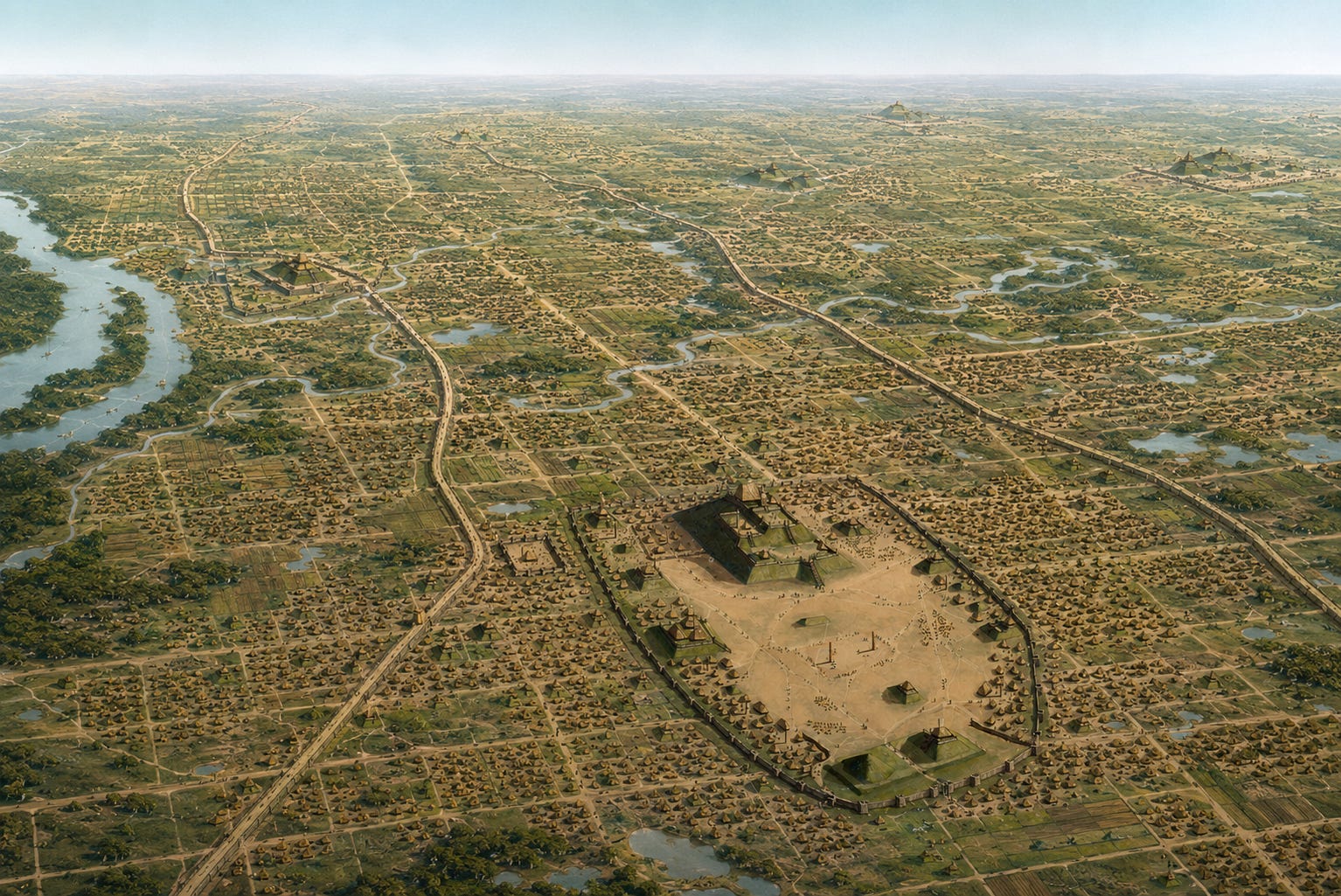
To find the real history of America, you have to stop worrying about what people say about themselves, and start looking at how they actually live. Is there anything in the past of this country that looks like a prototype of Miami or LA? Well, yes, in fact, there is. A thousand years ago, North America was home to huge, sprawling cities; the largest of them was a site near modern-day St Louis that archaeologists call Cahokia. At its peak in the twelfth century, Cahokia may have been home to more than 40,000 people, significantly more than London or Paris. It still didn’t have as many people as the real population centres of the time, like Baghdad or Kaifeng, but Cahokia was physically large in a way totally unlike any other city on Earth. The great cities of Europe and Asia—and, for that matter, Mexico and Peru—were crammed tangles of alleys and tenements. Abbasid Baghdad had a population density of around 14,000 people per square kilometre; so did Tenochtitlan. (For comparison, that’s nearly a third denser than present-day New York City.) Cahokia was something entirely different. The ceremonial centre was an enormous plaza, overlooked by Monks Mound, a hundred-foot earthen mound, vaster than the Great Pyramid of Giza, crowned with two buildings, probably a royal palace and a temple. There were twenty or thirty more mounds ringing the square: maybe three million tons of soil dug out of the ground and piled up in baskets. This complex was surrounded by a wall five metres high and two miles long, made from twenty thousand enormous logs, and after that the real city began. A typical house in Cahokia had one room, maybe 180 square feet, with a thatched roof and walls made of saplings and reeds, but there were thousands of them. Beyond the ceremonial core the city sprawled in every direction: houses spread out in an immense grid, wide pathways within neighbourhoods, elevated causeways connecting them, here and there subsidiary ritual complexes, more temples, more palaces, more workshops and gardens, sweat lodges, astronomical henges, suburb after suburb, stretching into the far distance. We still don’t know exactly how extensive the place was; less than 1% of the site has been fully excavated. During construction of the I-270 freeway in 1978, the construction crew dug up the footprints of hundreds of undiscovered houses. Magnetometry is still discovering new sites miles and miles away from the monumental zone. With all this uncertainty it’s hard to get a precise figure, but Cahokia’s population density was probably around 500 to 1000 people per square kilometre, pretty much in the range between Los Angeles County and Miami-Dade. Something like this:
The other interesting discovery at Cahokia was the corpses. In 1967, a University of Wisconsin-Milwaukee team led by Melvin L Fowler discovered an elite burial at Mound 72. A man and a woman had been interred, atop a beautiful carpet of twenty thousand shell beads arranged in the shape of a bald eagle. At their feet were the remains of more than fifty young women, all under 25, all apparently strangled. Elsewhere at the site were mass graves of victims who died with their skulls caved in or sliced off, hack-marks in their bones, arrowheads in their ribs. Some of the skeletons had soil clenched in their hands: these sacrifices had been buried alive. A thousand years ago, there was something at the confluence of the Mississippi, Missouri, and Illinois rivers that looked exactly like the United States of America, and behaved exactly like the United States of America too.
Unfortunately, it’s hard to say much for certain about what the society that built Cahokia was really like. We have their mute material stuff; we know they sat at the centre of a trading zone that stretched from the Great Lakes to the Gulf Coast; we have their DNA, which tells us that the city was a cosmopolis, with its population drawn from every corner of North America. We know they played a game called chunkey—where you roll a disc across the ground and then try to throw a spear at it such that it lands very close to the disc but doesn’t actually hit it—because we keep digging up chunkey discs. A lot of them were decorated with what look like underworld motifs, or man-headed eagles clutching a sheaf of arrows. This seems like something that might be important, but we can only guess what it meant. We can’t ask how they saw the world, because these people left no writing, and not long after the zenith of Cahokia the entire society collapsed in spectacular fashion and for totally mysterious reasons. The site was totally abandoned; for centuries the fertile flood plains where it stood were a desolate place, religiously avoided by whatever survivors still haunted the woods, until eventually everyone forgot that the mounds were anything other than hills.
Almost everyone, anyway. One offshoot of the Mound Builder culture that produced Cahokia did survive long enough to have been described by European explorers. They were called the Natchez, and they lived five hundred miles downriver in what’s now southern Mississippi. In 1682 they were visited by René-Robert Cavelier, Sieur de La Salle as he was attempting to claim the entire American interior for France. Like a lot of the Europeans that followed him, La Salle found the Natchez strangely charismatic: they were a tiny, measly, impoverished tribe, a few thousand people at most, but they were ruled with a kind of despotic grandeur. Their poky villages were arranged around two tall earthen mounds, and on top of those mounds the Great Sun lived and tended the eternal fire in his temple. The Great Sun was a filthy savage covered in tattoos, eagles and serpents, with a ridiculous crown of eagle feathers on his head, but to the Natchez he was literally the Sun, the living embodiment of the Sun on Earth. Natchez were forbidden from looking directly at either his earthly or celestial body; whenever he appeared they wailed and bowed their heads. The Great Sun had the power to kill anyone he wanted, or seize anyone’s property at any time; when he died dozens of his followers would be killed with him, and then all their bones would be strewn around the temple fire, which was also a fragment of the Sun. (The Natchez were convinced that if the fire ever went out, the world would be destroyed.) The other tribes La Salle had encountered were egalitarian woodland bands, but the France he’d left was also governed by a sun-king; this one was called Louis XIV. The Natchez must have seemed like God’s parody of home.
But in fact, the ethnographic corpus on the Natchez describes a very strange society. Their language is an isolate, unrelated to any other known Native American language, or any other language on the planet. Their social setup similarly resembles nothing else in human history, with the sole exception of the present-day United States of America. See, for instance, their class system. They had a strict hierarchy: the Suns, or the royal household, were at the top, followed by nobles, honoured people (a caste of warriors, bureaucrats, and executioners), and finally the foul-smelling ones or stinkards, which is how the Natchez described the commoners who made up nine-tenths of their own population. This is, historically, fairly common; the strange thing is that these noble castes were strictly exogamous. Suns and nobles could not marry other suns and nobles; they had to marry stinkards. What’s more, Natchez society was matrilineal. The children of a noble woman would keep their mother’s status; the children of a noble man would lose one rank per generation. When a noble woman married a common man, the husband would usually become a kind of domestic servant, generally abused and humiliated by a wife who was more or less free to go out and fuck whoever she wanted. We have marriage to guarantee paternity, but for the Natchez paternity wasn’t particularly important; their institution of marriage was extremely weak. Meanwhile, when the Great Sun died, his heir wouldn’t be any of his own children, but his oldest sister’s son. For all his infinite power, the male-line great-grandchildren of the Great Sun would be ordinary stinkards.
What Natchez society produced is a historically unprecedented level of class mobility. The hierarchy is very present, and extremely brutal, but over time the entire society is drawn gradually upwards. This is what anthropologists have called the Natchez Paradox. The children of noble women and stinkard men are all automatically nobles, while the children of the opposite pairing only decline one step per generation, which means there are always more stinkards climbing up the class ladder than there are nobles descending. Game this out for a dozen generations or so and soon there are more nobles than stinkards. A large and growing number of nobles are left with no one they can legally marry. This seems impossible, which is why in 1971 White, Murdock, and Scaglion successfully solved the paradox by replacing the Natchez social system as described by everyone who actually encountered it with another that made more mathematical sense. But there is another solution. The paradox stops being a paradox if Natchez society keeps constantly integrating immigrants at the stinkard level.
According to the Natchez themselves, the reason for this bizarre system was to prevent incest. Antoine-Simon Le Page du Pratz lived among the Natchez in the 1720s; they told him a story in which the first Suns, ‘being brothers and sisters, were unable to intermarry without committing a crime, and it was necessary in order to have descendants that they marry stinkard men and stinkard women.’ If you know anything about psychology you’ll know what’s really going on here. The omnipotent Great Sun could, if he wanted, ensure that his own children would succeed him; all he has to do is fuck his sister. The system that’s supposed to prevent incest actually makes incest incredibly tempting. In the rest of the world, the great structuring incest-fantasy is parental, Oedipal; only the Natchez are obsessed with brother-sister incest instead. According to Freud’s myth in Totem and Taboo, this shouldn’t be possible. Society begins as a horde of apelike creatures, in which the great patriarch has unlimited sexual access to the women of the family, while his sullen, brooding sons don’t get anything at all. Eventually the jealous sons band together to kill their father. ‘Of course these cannibalistic savages ate their victim. This violent primal father had surely been the envied and feared model for each of the brothers. Now they accomplished their identification with him by devouring him and each acquired a part of his strength.’ As soon as they do, though, they’re wracked by a sudden terrible guilt. It’s suddenly impossible for them to start sharing out the father’s harem. In the end the brute selfish prohibition of the primordial father becomes the superego’s first ethical command: NO SEX WITH YOUR OWN FAMILY. The patriarchy is born.
But Freud had, in fact, encountered a society that functioned very differently. After his visits to America, he started describing it as a society of brothers, a society without the hereditary male line of kings, without the father, without the paternal principle at all. Somehow, in America, things got suspended in that moment of triumph when the brothers eat the corpse of their father, before they knew how to feel guilt. Europeans live in an Oedipal world of structures and prohibitions, a long-settled order that you can slot yourself into by fucking your mother. Not Americans. America is a world of dangers and possibilities that you explore by fucking your sister. Haven’t you seen the porn they make over here? What are you doing, stepbro, now you’re liberated from all patriarchal bonds? This is what it means when they talk about Liberty and the Rights of Man; it’s all code for sisterfucking. It doesn’t have anything to do with personal independence; you’re still stuck in a hive-like hierarchy, subject to the terrifying power of the Great Sun, but your incestuous fantasy is arranged horizontally instead of vertically. And that really is a kind of freedom; maybe the only kind to ever really exist.
One last interesting thing about the Natchez. During his time with them, du Pratz asked his hosts where they’d originally come from. They pointed, and told him that ‘before we came into this land we lived yonder under the Sun.’ They thought they came from somewhere far away, over the distant oceans to the East: of course they did; they were religiously obsessed with the Sun, and the land over the eastern horizon is where the Sun travels from every morning.
Actually, one more. In the Natchez language, the first Great Sun’s title is uwahšiL, pronounced oo-wah-shee-hl. According to the mythic origin of the United States, it was founded by a man called Washington.
What really happened in 1776? Probably nothing at all. The present-day United States had to come from somewhere, but I don’t think it emerged directly out of the Natchez. It can’t have; they were all wiped out. In 1729 they attacked a French trading post at Fort Rosalie, killed all the men and abducted all the women. The French liked the Natchez, but they didn’t like them that much. In response, they wiped out an entirely different tribe, the Chaoacha, who had absolutely nothing to do with the revolt, and then moved along the river, destroying every Natchez village they found. The Great Sun and his sisters were sold into slavery in the sugar plantations. Whoever survived fled north; the last heirs of Cahokia assimilated into the Muskogee. (Chateaubriand wrote an enormous prose epic about the Natchez, in which the total destruction of their society is dealt with in a few brief paragraphs right at the end. ‘Une nuit les Natchez déterrèrent les os de leurs pères, les chargèrent sur leurs épaules, et ils prirent la route du désert sans savoir où ils trouveraient un asile.’) The USA must have come out of somewhere else.
Most likely, the Natchez were just an offshoot, and the Mound Builders just an offshoot, of a culture that has always existed on this continent. For a while it was disorganised, and there were Frenchmen and Spaniards running around in North America, and later it formed a state, and the same Europeans turned into desperate immigrants. This pattern’s been going for a while. Before Cahokia there was the Hopewell Interaction Sphere, a continent-spanning cultural nexus that raised earthen mounds across Ohio, and strangely spread-out cities around them. Before Hopewell there were the people who built Poverty Point, an enormous monumental earthworks constructed in Louisiana around 1700 BC, the same time as the golden age of Knossos and Babylon. We know almost nothing about the Poverty Point people, but I can guess. Their language was unrelated to any other Native American language. They had a highly stratified class society with a bizarrely high degree of social mobility, exceptionally weak marriage bonds, no Oedipus complex, and a kinship system that ought to be mathematically impossible. They deployed eagle or birdman imagery. They were hungry for immigrants, a constant flow of warm bodies to keep all the moving parts in their society moving. They believed they came from a distant land under the sunrise. They lived in wide, dispersed settlements. They practised human sacrifice. They were Americans.
We know America has always been there, because the people of the Old World knew about it. Long before the alleged voyage of Columbus, Europeans were telling stories about the land of sexual freedom and material plenty that lay across the western ocean. All cranks inevitably mention Atlantis, but surely it’s significant that Plato described a place beyond the Pillars of Hercules, with mountainous coasts and a broad central plain, perfectly square fields, a wealth of rare minerals, ruled by a highly advanced empire—and that place turned out to actually exist, exactly as described. (One fun detail: in the Critias, Plato says that the Atlanteans were born from Poseidon and a mortal woman called Cleito. To keep Cleito safe, the god ‘enclosed the hill in which she dwelt all round, making alternate zones of sea and land, encircling one another; there were two of land and three of water, which he turned as with a lathe.’ There is only one such island on a lake on an island on a lake on an island on a lake, anywhere in the world, and it’s in North America. It was discovered in 2012 by people clicking about on Google Maps.)
But obviously Atlantis isn’t the only memory. The Irish knew about the enchanted land of Uí Bhreasail or Hy-Brasil, a paradise of youth and plenty hidden in the misty seas to the west. Across Europe, peasants dreamed of the Land of Cockaigne, where the weather is always wonderful, ready-roasted pigs trot around with knives in their backs for easy carving, nuns bathe naked in rivers of booze, and any man can sleep with a different woman every week. This place is real. Go to the hot food bar at Erewhon, stumble around half-paying attention, looking at your phone, swiping on Feeld while gorgeous women in their athlunderwear mill about you unseen: the peasant paradise exists. Maybe all this easy fulfilment totally neuters desire, but no one ever promised it wouldn’t. You dreamed of a land where cooked geese would fly into your mouth, and now you can summon siu ngo on Doordash. It’s real. And where did the fourteenth-century poets say it was? ‘Fur in see bi west Spaynge/ Is a lond ihote Cokaygne…’
If the 1776 narrative refers to anything, it’s probably a few minor skirmishes with the European kingdoms, bolted onto events that took place very long ago. A half-remembered solar leader with a title that sounded like Washington, who led a local rebellion against a previous centralised state. The other Founding Fathers are, like King Arthur and his knights, a grab-bag of dimly remembered historical figures, secularised deities, and culture-heroes. Thomas Jefferson originally had a role similar to the Tattooed Serpent among the Natchez, who was the younger brother of the Great Sun and usually his diplomatic representative with other tribes. Benjamin Franklin’s name is probably related to shankolt, the Natchez word for a bird: native American traditions generally identify the bird as a trickster figure, ancient keeper of arcane wisdom, the bringer of lightning who knows the secrets of the sky. Alexander Hamilton is most likely a corn god, borrowed through contact with Uto-Aztecan peoples, a figure of plenty and increase, the first fruits, all paid for with a tax in human blood. Corn deities are often also underworld deities; in Nahuatl the phrase for something coming from the Underworld would be Hualmictlān. At some point the list of presidents transitions from mythological figures to actual historical leaders, but it’s anyone’s guess where the actual boundary is. Van Buren? Lincoln? FDR? It doesn’t really matter.
More interesting to consider some of the other stories. According to the 1776 narrative, the Great Compromise at the Constitutional Convention led to the creation of an upper and lower house on Capitol Hill. But this is clearly a just-so story: you might remember that the Monks Mound at Cahokia was also a hill divided between two houses, the palace and the temple; the Natchez were similarly bicameral. The Senate and House have lost most of their religious function in the last thousand years, but not all of it. There’s a persistent story that the US Capitol contains, in its catacombs, an eternal flame, guarded by an ancient cryptkeeper paid to make sure the fire never goes out. This is allegedly an urban legend, but it’s an urban legend that was repeated by at least one actual US President, James Garfield, who wrote in the Atlantic Monthly that ‘in the crypt constructed under the dome of the Capitol, as the resting-place for the remains of Washington, a guard was stationed, and a light was kept burning for more than half a century.’ Maybe the same flame was rescued from some mound-temple, where it once scorched the bones of the first President and those of his human sacrifices.
But there are other questions, too big for me to really even consider. I said before that when you’re flying into LAX the city looks like an enormous abacus, a computing device made of human lives and human desires, and maybe our deaths as well. The United States of America has been building these machines for at least three and a half thousand years. What are they for? What do they do? I don’t know. I think it’s possible they don’t always work perfectly. This is evident once you’ve driven around LA a bit. Something’s clogged, the freeways are all jammed up, the gears are straining against themselves. Some psychic fluid leaking from the city, which is why half the people on LA city buses look like they’ve seen the true face of God and found it full of fangs. Sometimes there are catastrophic errors, and you get stuff like the sudden depopulation of Cahokia. But whatever this thing is doing, it’s hard to imagine that it’s for us. The Natchez thought that their political leaders were manifestations of the celestial world; maybe they were right. The city-machines could be tunnelling through the stuff of the universe, opening it up to whatever unfathomable timeless world it is where America really began, all so some being, visibly or invisibly, can walk the surface of our tiny hurtling rock. Maybe they’re just ancient data centres, generating twelve-dimensional alien porn. Maybe we’ll never know.
However terrifying the real answer is, though, it’s still better than the alternative. Imagine if it were all really true, George Washington and tricorn hats and the Declaration of Independence in 1776, all of it. If that were true, then that would mean that the United States is a propositional nation that no longer believes in its own proposition, can barely even comprehend what those dead men in wigs once meant by liberty or enlightenment, the idea of humanity growing out of its self-imposed childhood, because the realisation of that idea is a society of children, scared in the world, desperately wanting someone to tell them what to do, some vast impersonal system of rewards to tell them what to desire, a society that can’t recognise itself in the mirror of history, left with nothing at all, just the world’s biggest cars, the world’s firmest tits, the world’s most overflowing supermarkets, the world’s most advanced bombs falling on distant villages on the other side of the world. But that can’t be it. You really believe that? You really think we’re all speeding rudderless into the future? That’s crazy. No way, man. It’s been like this forever. It will be like this until the last suns die.