

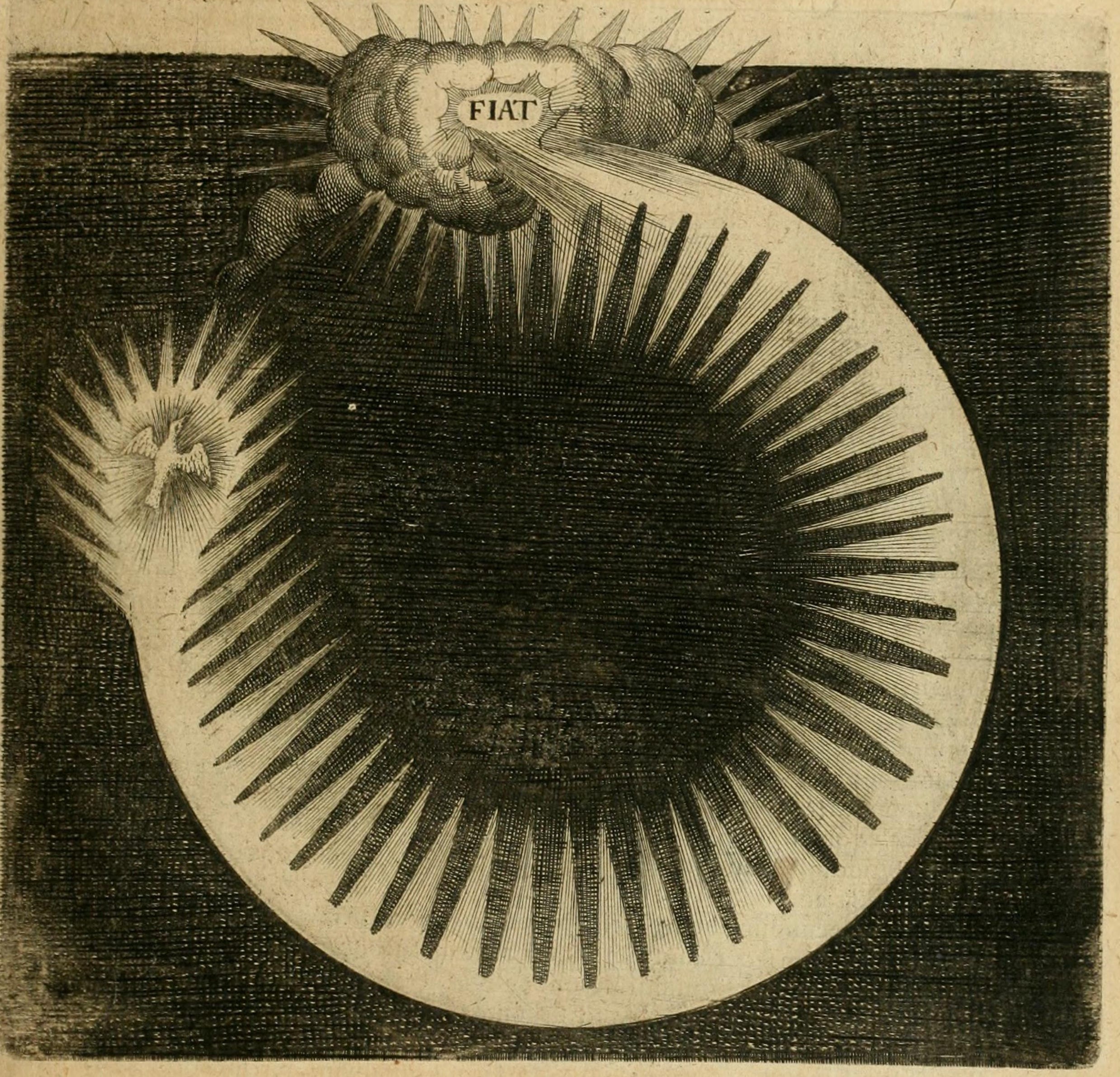
For E., again.
One thing you might not know about me is that I am an alchemist. If you came to my home, you’d find that this place—which was once a totally ordinary flat in a totally ordinary council estate in London—has been gutted and overthrown. Every surface is covered in tortured glass vessels, aludels and alembics, bubbling over the rough furnaces I’ve built over the bare concrete floor. Old jam jars and jugs from Ikea that now contain vitriolic compounds, butter of antimony, unctum of arsenic, water of Mars. Great piles of tattered incunabula: the Summa perfectionis of Geber, the Mineralibus of Albertus Magnus, the Quintae Essentiae of Johannes de Rupescissa. Astrological charts, great spidery diagrams relating the seven metals to the seven bus routes that pass by my estate. In what’s left of the kitchen there’s a half-mutilated fridge collapsed on one side; I’ve been extracting the isobutane out the back and trying to cook out its essential salts. I’ve been experimenting with using the microwave as an athanor: cramming it full of various distillates, cranking it up to full, and observing as the chamber fills with violent sparks. Excitation of the philosophical fire. I’ve pulled a bunch of copper wires out of the walls, dissolved them in aqua fortis until they formed a striking blue fluid, coagulated the liquid into prismatic blue crystals, and eaten a few of them to see what happens. (You become very, very ill.) My bathroom sink contains a greenish sludge I made by pouring twelve brands of shampoo and three types of surface cleaner into one big potion. So far I’ve managed to calcinate a few promising sulphurs out of the mixture, which I’m calling Spirit of Head & Shoulders and Oil of Toilet Duck. It’s not entirely clear what part Oil of Toilet Duck has to play in the Great Work of chrysopoeia, but I’m sure there’s something. Nothing in this world is superfluous.
Why practice alchemy? This is what a lot of people have been asking me. My neighbours, for instance. Occasionally the police. They keep bothering me with useless complaints about how extremely toxic fumes keep filtering into their homes late at night while their kids are sleeping. Why am I doing it? Don’t I know that attempting the Magnum Opus in a small flat in the year 2026 is not just dangerous, but pointless? We know better now. Transmutation is impossible. You can’t turn lead into gold. So what am I playing at?
This is one of the two main contemporary approaches to alchemy. It says that alchemy is basically just an inchoate and misguided precursor to modern chemistry. In some ways, the alchemists really did pave the way for the scientific method: they were admirably committed to experimentation; they really did try to understand the principles behind how the world works. If you look at the state of things before alchemy, it’s a mess. In the Natural History, Pliny says you can cure snakebite with a poultice made from a chicken’s brain steeped in wine, and prevent balding by burning a green lizard and mixing its ashes with bear fat and onions. How was this supposed to actually work? Not clear! But the alchemists were serious about discovering the hidden laws of reality. They kept dissolving and calcinating the familiar stuff of the world in search of its basic materials, and instead of the comforting classical elements they kept producing alarming vitriols and alien salts. They were getting somewhere. Unfortunately, they had to mix all this honest experimentation up with a load of other bullshit: astrology and numerology, Hermeticism and homunculi, the doctrine of signatures, the music of the spheres. The world is full of useful substances waiting to be discovered, but these people kept trying to summon angels instead. Eventually we managed to distil out what was rational and discard the scoria, which is why we can now make chemical fertiliser and anti-dandruff shampoo without any kind of wizardy business anywhere in the production chain. The stuff we left behind is mildly interesting as a historical curiosity, but you should not attempt to do it in your kitchen.
The second approach says that alchemy was never actually about ordinary physical metals at all. According to Jung and his followers, the whole project of transmuting lead into gold was always just a highly elaborate metaphor: the real object of alchemy is the alchemist himself. The lead you’re trying to transform is the stuff of your soul. Prima materia, confused and chaotic. The first stage of the alchemical process is nigredo, or blackness. In the laboratory metaphor, the material needs to be cooked down in a furnace until it forms a uniform black matter; what this really means is that you need to confront the dark and uncomfortable regions of your psyche. In the second stage, albedo, the material is dissolved and coagulated again. Alchemists were fascinated by dissolution: you immerse a solid metal in certain liquids and it simply disappears, leaving a scum of waste material you can skim off; then you can heat the liquid and a purified form crystallises, seemingly out of nowhere. What they really meant is that to remove the impurities from your soul, you have to abandon the ego, lose all sense of self, surrender to the aqua regia of pure being, and emerge again, reindividuated but transformed. The final stage is rubedo, the translation into gold. Surely you didn’t think gold was just a shiny metal. It’s psychology: the highest, most perfected version of yourself.
The first approach is boring and pedantic and wrong, but the second is infinitely worse on every front. The real secret of alchemy is not contained in the tiny damp space inside your head. It’s out there in the world. In the 1960s, the Soviet astronomer Nikolai Kardashev proposed a scale for possible civilisations: a Type I civilisation is capable of accessing all the energy available on a single planet, a Type II civilisation can access all the energy produced by their nearest star, while a Type III civilisation can consume the light of an entire galaxy. The reason I practice alchemy is that in 1564, England became the first Type II civilisation in the known universe.
Still, I do understand why the vulgar psychologists think the way they do. If you read the great alchemical treatises, they don’t sound like scientific papers. They’re full of dreamlike narratives, kings being eaten by dragons, lions devouring the Sun. Flick through the Splendor Solis of Salomon Trismosin, and you’ll find a vision of ‘a man whose body was dead and yet beautiful and white like Salt; next to him stood an ugly man of black and cruel countenance, with a bloodstained double-edged sword in his right hand, and he was the good man’s murderer.’ In the Rosarium Philosophorum there’s a king and queen who die together in the act of having sex, and are buried together, and in the grave they meld into a monstrous two-headed hermaphrodite. The Chymical Wedding of Christian Rosenkreutz is an entire extended narrative set in a bizarre allegorical castle, where there are soldiers hidden behind the stonework, the servants behead the hosts, and our hero stalks the halls at night to watch naked women as they sleep. All of alchemy carries heavy seams of sex and death. Some books don’t even bother with words at all. The Mute Book, attributed to a mysterious sage called Altus, consists entirely of gnomic images: angels ascending ladders to heaven, fiery monsters gnawing at children’s heads, animals prancing under the rays of a stormy sun. What does this actually mean?
The simple answer is that this is just a straightforward code. Alchemy was necessarily occult: making gold out of base metals meant interfering in the business of the state, which had the exclusive right to mint and issue coinage. If you have the secrets of transmutation, better to express them through a system of codenames. Planets are the most obvious: gold becomes the Sun, and silver becomes the Moon; copper is Venus, iron is Mars, quicksilver is Mercury. (That one stuck.) From there you can start introducing animal figures. In the Great Stone of the Ancients, stibnite appears as a ‘ravenous grey wolf’ that devours the king before being thrown in a fire. Molten stibnite easily dissolves other metals; if you put impure gold—the ‘king’—in a crucible with stibnite, then the dross will float to the surface, leaving a shining alloy of gold and antimony. If you really want to protect yourself, though, the best language is a religious one. The gold you’re trying to produce is spiritual gold; the alchemical recipe is a recipe for Christian salvation. Fill your treatise with discourses on the purification of the soul: that way, under the cloak of piety, you can keep tinkering with toxic chemicals until one of them makes you rich.
But it’s not quite as simple as that. One of the most cherished metaphors in the alchemical roster is sexual union, the marriage of the king and the queen. Generally, these represent sulphur and mercury. The idea, popularised by the (possibly mythical) medieval alchemist Jabir ibn Hayyan, is that all metals are a combination of these two principles. Mercury, which is a formless and protean liquid, provides the ‘body’ of the metal, or its feminine aspect, while volatile and fiery sulphur is the metal’s masculine ‘spirit.’ So it should be possible to turn one metal into another, by removing the sulphurous elements until you’re left with a pure unqualified ‘philosophical mercury,’ and then conjoining it with a pure spirit of sulphur. Something like sex, producing a new being, which is why the king and queen in alchemical texts tend to fuck until they coagulate. The gendered metaphor here is not really just a metaphor. Sexual difference is a scar running through the entire universe; you can see it in the sky, dividing the Sun and the Moon, and along the horizon, separating the earth from the sky. At the same time, these are the terms on which things relate to each other. Everything that exists is arranged in some kind of erotic tension with its opposite; the whole material universe is fucking behind your back. Alchemy is sex; it’s the sexual life of minerals. The alchemist’s daytime experiments and soft movements against another person at night are two expressions of the same omnipresent thing.
It’s all like this. Are the seven planets just useful codenames for the seven metals? Not quite. Tycho Brahe described alchemy as a ‘terrestrial astronomy,’ an earthly encounter with the superlunary world. There is something that appears as the planet Saturn when it’s in the sky, lead when it’s in the depths of the earth, the cypress when it grows from roots, the raven when it takes wing, and melancholia when it appears inside your mind. Jupiter is tin and the liver and the oak and the eagle and joy. When you eat garlic you’re ingesting a metaphor for Mars. In the twenty-first century any metaphor is a meaningless convention, but for the alchemist the deep grammar of the world is made of images, things representing other things in endless hidden chains. Peer deep into the subatomic bowels of reality and you’ll find a king on the ramparts of his castle, and a wolf stalking the wastelands, and a naked virgin floating in the stormclouds above. And religion is also held in this dense web of metaphor. When alchemists claimed that their practice was really an image of the soul’s journey to salvation, they meant it. The Great Work and the Christian narrative are one and the same thing. In alchemy, the material has to pass through a stage of blackening into ashes, death, before it can be resurrected in its metallic glory; there is, as the sixteenth-century mystic Heinrich Khunrath writes, a ‘wonderful harmony of the Philosophers’ Stone with Jesus Christ, and vice versa, placed verily by God not vainly before our eyes.’ The alchemical Stone must be possible, because ‘the blessed and heavenly stone exists in nature, from the beginning of the world.’ And Jesus was, in his own way, an alchemist: he spoke in parables. He contained the entire Kingdom in a mustard seed.
For Jung, this whole system of metaphors has an exit: there’s one level of meaning that’s really real, and all the others are just reflections. He chooses the microcosm. Your feelings, your sexual hangups, your difficult relationship with your father, the inner drama of your mind: when we talk about the distant stars and the molten core of the earth, we’re really just talking about that. This is, when you really think about it, a very strange idea. Mercury and gold are real. The Sun is real; it’s an enormous sphere of burning gas, 1.4 million kilometres wide. Whatever bullshit you’ve got going on is infinitely more ephemeral than that. But Jung was always a bad and cheap mystic, and among the early psychoanalysts the really cosmic stuff always belonged to boring old Freud. In Beyond the Pleasure Principle, he tries to reach back into the origins of our destructive and defeated desires. In the end, he concludes, ‘it must have been the evolution of our earth, and its relation to the Sun, that has left its imprint on the development of organism.’ Our inner lives are just a metaphor, representing something else, out there in the external world, huger than we can fully imagine.
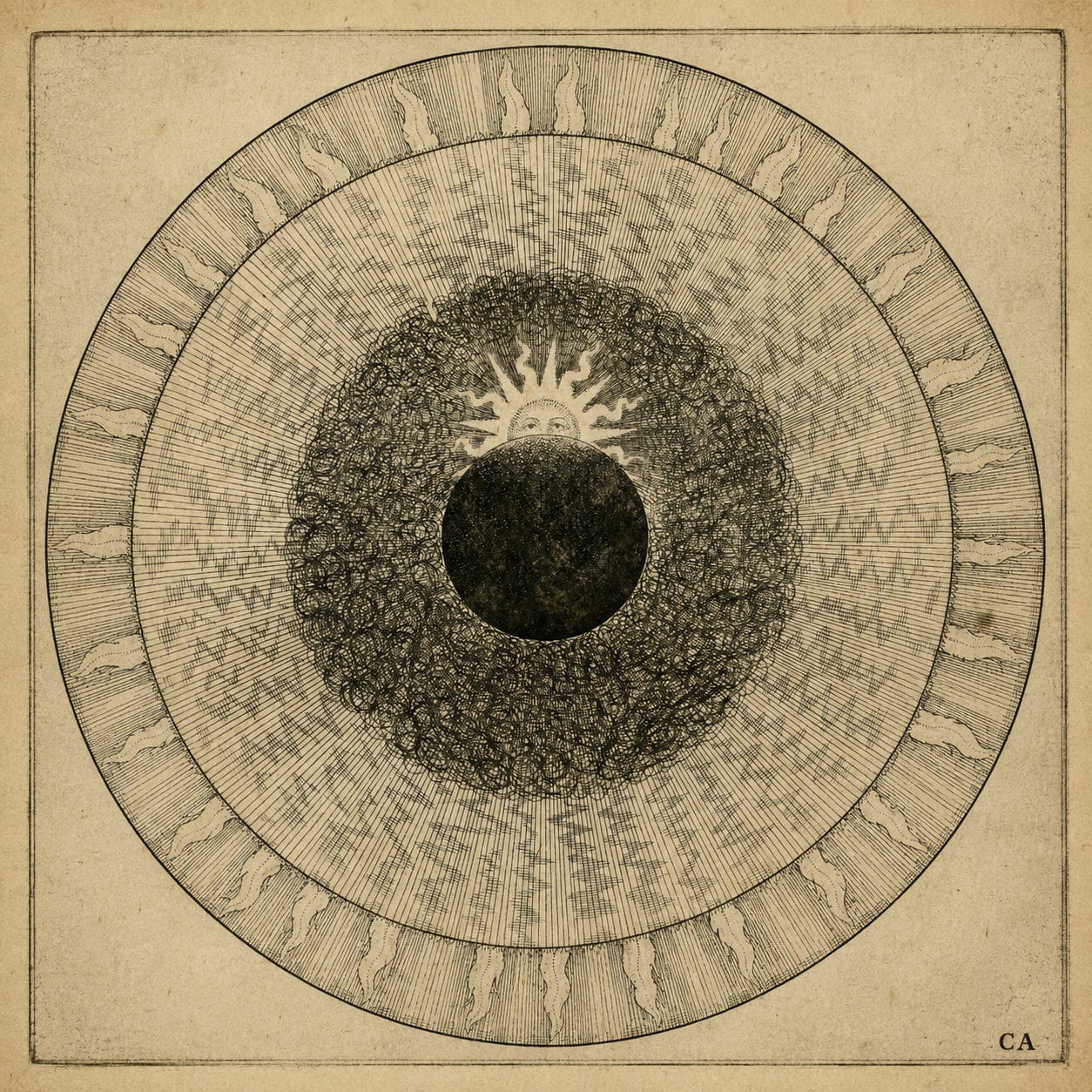
The ancients knew that there are only four really interesting questions in the world. I: Where do babies come from? II: Do animals partake in language? III: Do the images in mirrors have their own existence when we’re not looking at them? And IV: Is the Sun conscious? The classical quadriquaestium is broad enough that to properly answer any of them you have to learn about more or less everything that exists; for a long time all the sciences were divided between the four branches of ontogenology, zoglossia, scrycraft, and heliopsychism. This is why, well into the twentieth century, a few more conservative Jesuit universities in Latin America still had one department that had to teach optics, art, and demonology, and another that covered neuropsychology alongside nuclear physics. Alchemists have, maybe unsurprisingly, tended to insist that these four questions are really just different phrasings of another, greater question which is impossible to put into words, but which unites the four fields of the body, language, images, and the starry heavens. The highest question we can directly ask, though, is the one about the Sun.
Like most alchemists, I have a complicated and obsessional relationship with the Sun. Last month there was a partial solar eclipse across most of Britain; I went with thousands of other people to sit on the ash-dry grass of Primrose Hill and watch the world go dark. My fiancée had made a pinhole camera out of a box of Protein Boost Berry Granola: peer through it and you’d see the circle of light projected on the inner cardboard slowly turn into a horned crescent and resolve again into a circle. I didn’t do that. I stood in the middle of the crowd, half-mad from the heatwave and two-thirds of a bottle of M&S Crémant de Bourgogne, wreathed in Satanic pillars of vape, and stared directly at our star. (They tell you that you shouldn’t do this, but I went for my eye test at Specsavers the next day; they even stuck me in the Optical Coherence Tomography machine, and afterwards the optician said I had the plumpest, juiciest retinas he’d ever seen.)
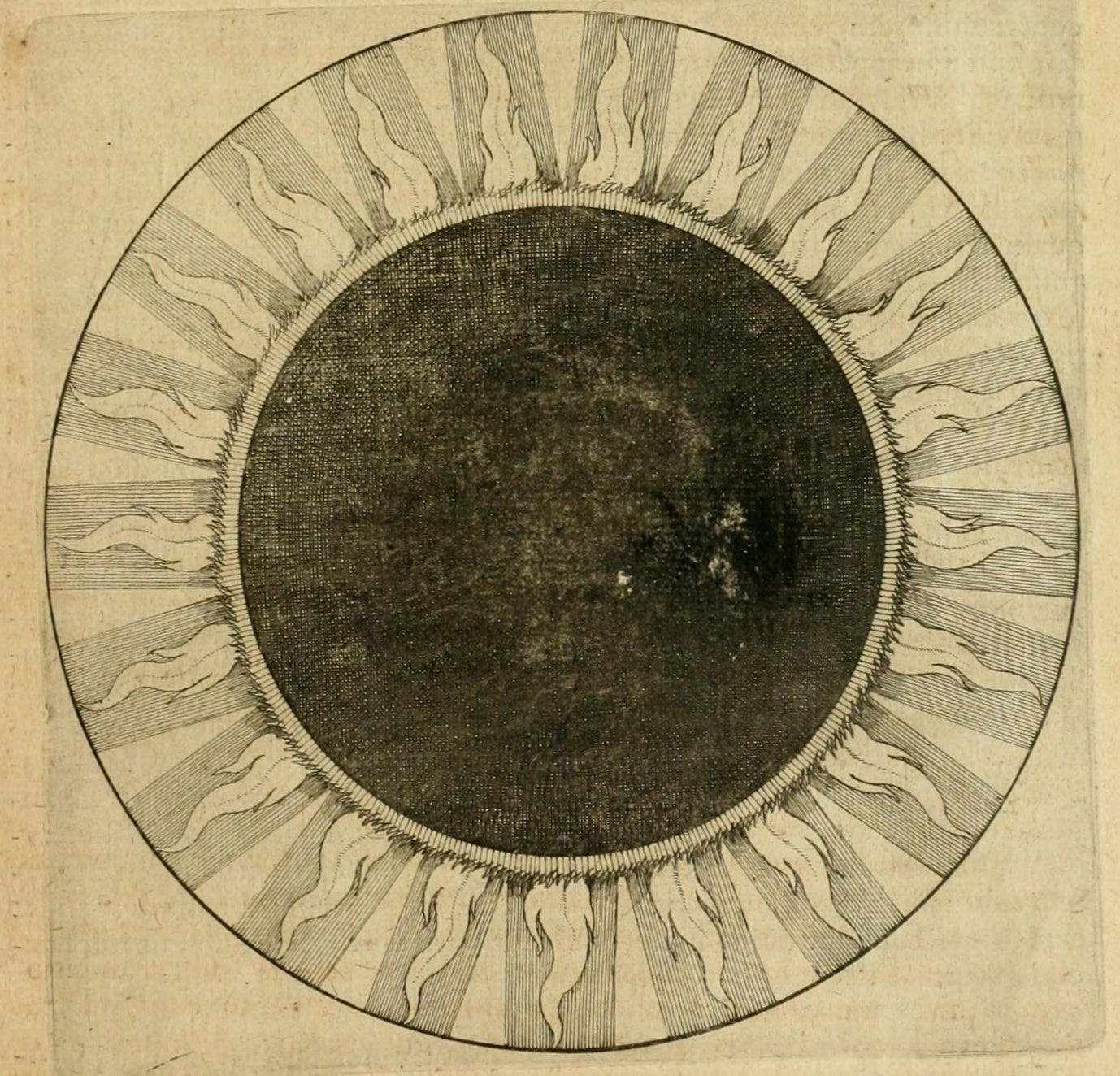
An eclipse, even a partial eclipse, is a deeply mystical event. They take place because the Sun is four hundred times larger than the Moon, but also four hundred times further away, which means that they’re exactly the same size in the sky. Any slight change to this ratio and there wouldn’t be that eerie corona surrounding a black devoured Sun, but there’s no particular reason why they should happen to coincide like that. No other planet we know of has eclipses the way ours does; two hundred million years ago the Moon was closer to the Earth and they didn’t happen here either. Our species came of age at precisely the right time to witness this miracle through a cereal box. The anthropic principle can’t save you here; nothing about the ratio between the Sun and the Moon makes our existence any more likely. The only sensible explanation is the alchemical one. The eclipse is there as a metaphor for nigredo, the dragon that devours the Sun, the first stage in the Great Work.
Sometimes, I also dream about eating the Sun. I’m holding this great bowling ball-sized Sun in two hands as I bite straight through its waxy photosphere to get at the jellied sunflesh beneath. Bursting the Sun against my teeth. You’ve seen the videos online of a hippo just going to town on a watermelon: like that. Messy eating. A coronal mass ejection, hot glowing sunjuice, dozens of solar prominences all surging at once. I slurp at the juice. Chowing down on the inner portions of the Sun, ravenous, like an animal. Tear away the surface in strips, the wispy corona and that thick waxy rind, until I’ve gobbled up all the soft flesh and all that’s left is the solar core, the densest part. A plasma so thick its constituent atoms start to collapse under their own weight. It’s chewy. Like caramel. Sunstuff puddles on the floor. My hands are sticky with it. They shine.
The philosopher and pornographer Georges Bataille was a latter-day alchemist. He got it. ‘The earth, by turning, makes animals and men have coitus, and (because the result is as much the cause as that which provokes it) animals and men make the earth turn by having coitus. It is the mechanical transformation of these movements that the alchemists sought as the philosophers’ stone.’ Elsewhere, he notes that there’s a ‘human tendency to distinguish two suns.’ There’s the preceding sun, the sun not looked at, which generously bathes the visible world in its light. While you’re in its glow, the Sun can serve as a symbol of reason and beauty and the Good, smiling ataraxically in the centre of a well-ordered universe. By its noble light we can count beads on an abacus and engage in healthful sports. But if you look directly at the Sun, suddenly you’re in the realm of madness, unbearable excess: this violent wound in the sky, raw and blinding like a chemical burn, festering, suppurating with great hot gouts of light. Four billion years evolving on this planet, and we still can’t handle the sight of our star.
But I keep trying to look at it; you can’t stop me. And I’m in good company. In 1665, Isaac Newton—who was, as everyone knows, an alchemist who happened to dabble a little in mathematics and physics—experimented on himself by staring at the Sun for as long as he could bear. His eyesight filled with grotesquely coloured circles and for three days he was practically blind. But afterwards, he found that the visions reappeared whenever he thought about the Sun. Nearly three decades later, he wrote to John Locke: ‘To recover the use of my eyes I shut myself up in my chamber made dark for three days together & used all means to divert my imagination from the Sun. For if I thought upon him I presently saw his picture though I was in the dark. I have been very well for many years, tho I am apt to think that I could still make the phantasm return by the power of my phansy.’ An image of the Sun had embedded itself inside his mind. Later, he seemed to make his discoveries by a kind of intuition: he just knew things; they simply appeared in his head. In 1684, he explained his theory of elliptical planetary motion to Edmond Halley; the astronomer asked him how he knew all this, and if he had a proof. Newton shrugged. ‘I’ve known it for years,’ he said. ‘If you’ll give me a few days, I’ll certainly find you a proof of it.’ That proof ended up being the Principia Mathematica. An ordered, rational text, but scaffolded around the madness of the scrutinised Sun.
Staring directly at the Sun is dangerous work; you’re putting yourself directly under the power of a ravenous god. Safer to use other channels: the metallic metaphors already laid out for you, and all the hissing leaking instruments of the alchemist’s lab.
Let’s say we accept that the world is held together by metaphor, and our daily lives are really a metaphor for the sky. This gives us more latitude than you might think. Metaphor is always slightly destabilising: it simultaneously blankets everything under a single interpretation and introduces points of autonomy and disjuncture. Derrida described metaphor as a ‘provisional loss of meaning.’ I might say that you, the reader, are a dog, padding around after me down this long stretch of text, making little whining sounds when you’re not sure exactly where we’re going. It’s a nice image, but there’s always an ungovernable surplus: does this also mean that occasionally we have to stop so I can pick up your turds in a little biodegradable bag? Once we’ve introduced the dog, it already has the power to wander off by itself. What breed is this dog? Does it lope on long skinny legs, or scurry around with its tongue hanging out, making laboured breathing noises? Or maybe it’s not a dog, maybe it’s a whale. Maybe you wanted an image of obsessive hatred and desire, and you chose to represent it as an enormous white whale. But now this whale is creaking and buzzing in the deep oceans, with its hump like a snow-hill, swallowing up huge swarms of possible meanings like schools of fish, all the nameless things of which the mystic sign gives forth its hints...
Given all this, it should be theoretically possible to manipulate the grand metaphor from our end. Astrology is the attempt to measure the ways in which the celestial world organises and controls ordinary human life; alchemy is the attempt to use ordinary human life to control the celestial world. Transmute base metals into the fiery gold of the Sun. What you need is a machine, a machine capable of manipulating the threads of metaphor that tie us to the macrocosm. That machine exists. It was invented in 1564, and it looks like this:
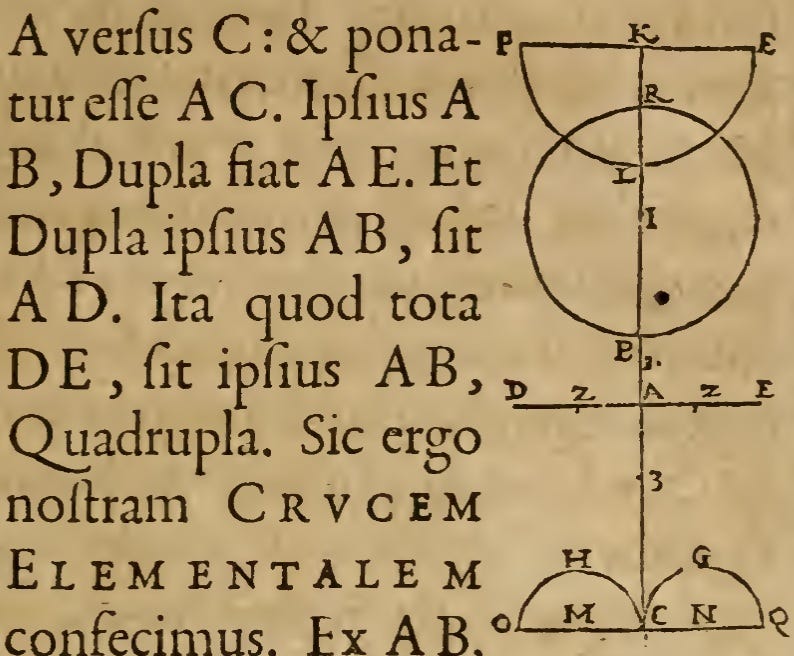
The machine you’re looking at is called the Hieroglyphic Monad, and it was invented by John Dee, court mathematician to Elizabeth I and England’s greatest wizard. It consists of the alchemical glyphs for the Sun and the Moon, a cross, and the sign of Aries. If you think these are just arbitrary signs, you’ve not been paying attention: nothing is arbitrary, and the shape that symbolises the Sun is in some sense the Sun itself. This monad is the entire macrocosm, in a condensed and modular form. By manipulating its lines and circles, rearranging them so they converge and radiate from different points, it’s possible to derive the symbols for all the other planets. So, for instance, in Theorem XII Dee rotates the Moon around the cross to produce Saturn, and again to make Jupiter; each operation redirects the flows of light and power that pour out from the Sun, creating different assemblages of metals and plants and animals in the sensuous world. After a full series of rotations you can geometrically derive a recipe for philosophical mercury. (Dee calls these ‘hieroglyphical syllogisms.’) The cross itself can be opened and divided to produce the numbers 1, 10, 100, and 252, along with the word LUX. There are other, stranger mysteries hidden in the inner workings of the monad, which ‘should be studied silently rather than divulged openly in words.’ He ends with an abrupt Latin postscript: Vulgaris hic oculus caligabit diffidetque plurimum. ‘Here the vulgar eye will grow dim, and despair greatly.’
The machine works. Your eye might be too vulgar to understand exactly how it does so, but you can tell it works just by looking at the career of one John Dee. His strange and antiquarian ideas didn’t only extend to alchemy and mysticism. He was also the first person to conceive of a ‘British Empire,’ a concept he’d derived from the medieval Welsh Historia Regnum Britanniae and Brut y Tywysogion, along with his conversations with the archangel Michael. He wrote an impassioned pamphlet for Elizabeth, insisting that this mystical empire should begin by laying claim to the territory of North America. In 1564, England was a restive, miserable, second-rate power. It had lost Calais, its last toehold on the European continent. Previous monarchs had so thoroughly debased the currency that the rest of the world refused to take English gold and silver. A resource extraction zone, supplying wool to Antwerp and Bruges. The idea that this wet and backwards island could turn itself into a globe-straddling empire would have seemed utterly absurd.
But an empire is a crude and ugly thing, and subjugation is the most debased form of power, far less potent or efficient than poetry. (Maybe it’s significant that in the same year that England became a Type II civilisation, in the geographic centre of the country, the fulcrum of the cross in the heart of the monad, a boy was born and christened Guilielmus Shakspere.) The real secret of alchemy is that everything we do tugs, in some way, on the swirling drama of the macrocosm. There are funnels of plasma, fifteen million degrees and bigger than worlds, coiling and surging in the great glowing brain in the sky, and here they express themselves as a missed train, or a song stuck in your head that you’re not sure anyone ever actually recorded, or a cat that won’t stop yowling at an empty room. Any deliberate attempt to rearrange the atoms of creation has its astral correlate. You rotate a few shapes on paper, or add one metal to another in a flask, and the sky changes. A five-year-old alchemist starts mixing toothpaste and ketchup just to see what happens, and instantly concentrations of magnetic flux send dark spots scattering across the photosphere. Practical alchemy is useful, because it provides a readymade set of correspondences for people with unusual lives, but higher mysteries are conjured every single day.
Another thing you might not know about me is that last week, I got married. I stood under a chuppah in a back garden in London, repeated some words in a language I don’t understand, and put a gold circle on her hand, and then I smoked twenty cigarettes and danced to some UK garage classics for nostalgic millennials. It was a wonderful night. But that’s all just a metaphor, that’s not what really happened at all. What it really means to truly fall in love with another person is that four and a half billion years ago, somewhere in the sterile blackness of outer space, an immense lead-grey cloud of gas and dust coalesced until it caught fire, and you and I invented the Sun.