
Good and evil in Iran
I forgot I was a king’s son, and became a slave to their king

Goodness exists everywhere; evil was invented in Iran.
The first person to discover evil lived in the Airyanem Vaejah or the Expanse of the Aryans, a zone of scrubland between the cold mountains and the endless desert. He was a priest, but the priest of a cattle-herding people. His name meant Managing Camels. His father was called Possessing Grey Horses. You have to imagine a slightly shabby figure, living in the dry expanses, probably a few fleas in his beard. Later, the Iranians would build a great civilisation, cities, temples, an empire, but not yet. Most of the year he travelled with his herds like everyone else, but in the ritual season it was his role to crush the sacred plants, and mix them with river water, and give the bitter liquid to the initiates. They worshipped little gods, warrior deities; you could summon them with certain plants; they might join you on a cattle raid. In his thirtieth year, Managing Camels was collecting water from the River Daitya, when he saw a figure on the opposite bank. The figure was nine times taller than a normal person, and he also happened to be glowing. The figure told him to take off his clothes, and he did; when the figure beckoned him into the river he discovered he was somewhere else, in a place that seemed to be made out of infinite light, so bright he couldn’t see his own shadow, and in front of him was a being made of infinite light as well, the true and only God. In the story, the light gives him a few banal homilies. It tells him that the best thing in the world is to have good thoughts, the second-best is to speak good words, and the third-best is to do good deeds. Not particularly thrilling stuff, but when he returned to his drab physical world, Managing Camels was willing to renounce his gods and the gods of his ancestors and live in the wilderness, cast out by his clan, hated, a universal enemy. It must have been the intensity of that light, more than what it said. Managing Camels spent the rest of his life wandering this dull, gloomy, shadowy world, composing anguished hymns to his God. Some of them still survive. ‘To what land can I go, where can I flee? My people are cut off from me, the rulers of the land despise me. How am I to please you? I know why I am powerless and impotent. I have no herds and no people. I cry to you: give me the help a friend gives to a friend. Teach me through righteousness how to attain the Good Thought.’
This is not unusual. People have sudden visions of God all the time; sometimes, for no obvious reason, an individual human subjectivity disintegrates, the mind falls out like a bowling ball through a wet paper bag, and a cattle-herder from some drab scrubland on the fringes of Asia is briefly plunged into the luminous infinity of being. Deal with that, says God, and vanishes. No one’s immune, but it seems to happen to cattle-herders in particular. People with names like Managing Camels or Horselover Fat. The difference is that this time, the luminous infinity of being told Managing Camels that it was not alone. There is another one like me, it said, but in the same way that I am made of light, the other one is made of darkness.
In his hymns, Managing Camels explains: ‘In visions they reveal themselves as twins, good and evil in thought and word and deed. When they came together in the beginning, they created life and not-life. Those who act well have chosen wisely between the two. In the end, Worst Existence shall be to the followers of evil, but Best Existence to him that follows Right.’ The evil god is called Druj, or the Liar. The little warrior-gods the Iranians had sacrificed to in the past were really the teeming demons of the Liar, who are constantly trying to tear the universe apart. ‘They are demons of ruin, pain, and growing old, producers of vexation and bile, revivers of grief, the progeny of gloom, and bringers of stench, decay, and vileness, who are many, very numerous, and very notorious; and a portion of all of them is mingled in the bodies of men.’ God created a beautiful sky and the Liar tried to blot out the stars. God created an enormous primordial bull and the Liar slaughtered it. God created humans, and wanted us to live in eternal happiness, but the Liar gave us suffering instead. This is why the body dies. A swarm of tiny demons are in there, ravaging the place, tearing nucleotides out of your DNA.
In his own language, Managing Camels was called Zarathustra; his vision became the state religion for a succession of great and glorious Iranian empires, one after another, for nearly two thousand years. Before Zarathustra, the Iranians were grubby herdsmen on the rocky edge of the world; afterwards they formed the world’s first universal multiethnic state. The little peoples they conquered were fighting for their own little patch of land and their own local gods; the Iranians knew that history is the scene of a cosmic battle between good and evil, and their duty was to chase evil out of the earth.
Dualism makes a lot of sense. It’s the only solution to the problem of evil that really does. It’s easier if you want to live in an amoral universe, where humans suffer because we’re at the mercy of childish and fickle gods, or if there are no gods at all. But if you want to imagine a good, kindly, loving, rational principle behind the universe, eventually you’ll have to contend with the fact that things down here are not always good or rational. You can say that suffering is a result of our freedom: God wanted us to be free to choose good instead of evil, which means there has to be a certain amount of evil in the world. But that doesn’t mean there have to be earthquakes, and there are. Mark Twain imagines God creating the fly. ‘Persecute the sick child; settle upon its eyes, its face, its hands, and gnaw and pester and sting. Settle upon the soldier’s festering wounds in field and hospital and drive him frantic while he prays, and betweentimes curses, with none to listen but you. Harry and persecute the forlorn and forsaken wretch who is perishing of the plague, and in his terror and despair praying; bite, sting, feed upon his ulcers, dabble your feet in his rotten blood, gum them thick with plague-germs. Visit all; spare no creature, wild or tame; but wheresoever you find one, make his life a misery, treat him as the innocent deserve; and so please Me and increase My glory Who made the fly.’ No mortal human would create the fly, ‘except under an assumed name.’ Why would God?
You can try to even out the balance of this fly-buzzing world with a blissful afterlife, where all our suffering is rewarded, and sometimes a nasty afterlife as well, where horrible demons will grab whoever hurt you and got away with it and saw him in half down the crotch. This doesn’t really solve things either. If it’s possible to create a rational world, where goodness is rewarded and evil is punished, why does this world have the stamp of irrationality on it? You can say that we need immense misery and suffering so we can appreciate what is good. C.S Lewis: ‘A man has no concept of a straight line unless he has seen a crooked one.’ But if you went to a restaurant where a starving African child was suspended from the ceiling in a perspex box like David Blaine, I don’t know if it would make you more likely to enjoy your meal. At a certain point it makes a lot more sense to say that evil is not just privation, the absence of good, distance from God: evil is its own thing. There are two gods and one of them is evil; that’s why the world looks the way it does.
This does still leave one question. This other god: what’s his deal? Why is he like this? You could argue that he’s mindless. He doesn’t know why he destroys. He’s not volitional; he’s the second law of thermodynamics. There is a force in the universe that produces glowing stars and galaxies; there is also a force in the universe that’s currently trying to disperse everything that exists into a thin and featureless cloud of electrons, muons, and neutrinos. The Bundahishn has another answer. God and the Liar are twins, but they’re not the same. In the very beginning, when they came into being together, God could see the entire cosmos from his throne of light. He knew the Liar was there. But the Liar, in his abyssal cloud of darkness, thought he was alone. He didn’t realise he had a brother. He only discovered that there was something other than darkness when he floated out of his pit and caught the first faint ray of light. It was agony. God can endure the dark, but for the Liar light is unbearable. He keeps trying to destroy the universe because the existence of the universe is torture: because God—who always knew he was there, and knew exactly how this would affect him—is choosing to torture him. All the Zoroastrian sources agree that at the end of time there will be a Frashokereti, the Final Day when the Liar is defeated.
Even if dualism makes a lot of things much easier, non-dualists tend to find it upsetting. Mystical thought tends towards unity, what Freud called the ‘oceanic feeling’: I am the world, the world is me, a general milky oral-stage oneness. When people have spiritually transformative ayahuasca trips, they don’t usually experience reality as a field of self-sufficient Leibnizian monads. But dualism says that there is a scar in the world, and you will not be able to reduce reality to a single principle. Other people live in one coherent universe; Iranians are caught between two. Something creepy about it: these twilight people in their in-between world. It doesn’t matter if you dedicate your life and your civilisation to fighting evil: once you make evil an active principle in the world it’s there to call on, or there to call on you. The Greeks were darkly fascinated with the figure of the magos, the Iranian fire-sorcerers who whispered in the ear of the Shahanshah, interpreting his dreams, divining the stars, healing disease, controlling the weather, exposing dead bodies on towers of silence to be devoured by vultures, and summoning demons. These are the origin of our words magic, magician: a person who consorts with unclean supernatural powers to do harm to others, or, sometimes, a charlatan who pretends they can consort with unclean supernatural powers to do harm to others. In Pliny, Zarathustra is the first magician, but his ‘magic is detestable, vain, and idle, and though it has what I might call shadows of truth, their power comes from the art of the poisoner, not of the Magi.’
Still, something happened in the shatter zone between the Greek and Iranian worlds, from the Tigris to the Mediterranean. The Greeks might have thought Iranian cosmology was sinister and unwholesome, but the peoples in the Iranian orbit were fascinated by the strange spiritual doctrines of this people from the mysterious West. In particular, an esoteric teacher called Plato, who said that the world you perceive though the intellect is the true one, and the material world is false.
The difference is that Plato lacked a concept of evil. His creator is good; being good, ‘he wanted everything to become as much like himself as possible. This, more than anything else, was the most preeminent reason for the origin of the world’s coming to be. God wanted everything to be good and nothing to be bad so far as that was possible.’ The rational resembles God more than the material does, but even if the material resembles God very faintly, weighted down by necessity, it still points unerringly towards the Good. Plato lived in a placid static Greek aristocratic world, where everything is made of white marble and pleasingly proportioned, and the olive-harvest is ripening in the hillsides, and the Etesian winds blow bright salt-spray on the docks, on the slaves carrying barrels of good dark wine from the black-hulled ship, and the sun shines on everything and everyone is fuckable and everything is good. If you unleash the same idea on people like the Iranians, who can constantly feel evil grasping at them from underneath the surface of the universe, you get something else.
These days, maybe it’s a dispositional thing. First these ideas emerge in history, afterwards they emerge in psychology. There are some people who are capable of looking at this world, flies and earthquakes and all, and saying: it is good. When I was younger I found them terrifying and incomprehensible. To love a world where so many people are suffering feels morally wrong. Now, sometimes, I think I get it. The world exists, we’re here; what more could you possibly want? Philip Larkin, not usually the most cheerful man, called it ‘the million-petalled flower/ Of being here.’ (In a poem about death, admittedly, but aren’t they all?) I think it helps if you’re in love. But most people can’t do without the devil, even the ones who don’t believe in him. They need a name for the subterranean principle breathing wrongness into the world. When someone uses the words ‘late capitalism,’ you can’t really be sure at first whether they’re an actual historical materialist or whether they’re just using another name for Druj. He has lots of names these days.
A few people, though, go further. When I was much younger, I was one of them. Maybe it’s inevitable: any skinny, brainy kid who’s too spastic to play football with the other boys will end up seeing the world in the same way as the Mandaeans, and the Manichaeans, and the Basilidaeans, and the Elchasaites, and the Ophites, and the Zurvanites.1 The cults who said that there is no demon trying to break into the world: this is his house. You have been living in his house from the moment you were born. This body you think is yours: it belongs to the beast. A prison made of carrion. For some people, everything the senses touch is disgusting. ‘This world,’ says the Gnostic Gospel of Philip, ‘is a corpse-eater; all those who eat within it shall die themselves.’ The being that created this corpse-eating world is not made of infinite light. His name is Yaldabaoth, and he is a lion-headed serpent-demon, a blind idiot, howling and defective. According to the Pistis Sophia his realm is the outer darkness, which is the jaws of the dragon. ‘And out of the jaws of the dragon cometh all ice and all dust and all cold and all different diseases.’ But in his dark cloud of ice and disease, he thinks he is the only god. In the lowest depths of the cosmos he made this universe for himself; scattered its stars. He trapped a few small fragments of the divine light in his muddy little creation: we are those sparks. He appeared to Moses in a burning bush and told him to worship him. Right now, billions of people are giving praise to Yaldabaoth. We’re his hostages, and we don’t even realise it. ‘I forgot I was a king’s son, and became a slave to their king. I forgot the Pearl for which my parents had sent me.’
In a way, all this stuff was there from the start. Zarathustra says the evil god is a liar. What is lying? Creating a false world. But this new dualism is weirder, more tragic, than the old one. Once there was a good god who made the universe because he loved us, and an evil god who keeps trying to destroy it because he hates us. Now the good god still loves us; he’s trying to rescue us from the flesh. But Yaldabaoth loves us too. That’s why the evil spirit built us these dying, corpse-eating bodies; that’s why he built us this broken world. He wanted to make a home for us. Everything he creates is monstrous, but he’s trying. He doesn’t know.
Someone had to stand up for the devil; it ended up being Mansour al-Hallaj. In Arabic, a hallaj is a wool-carder, someone who spends their life doing the tedious work of combing big fluffy balls of wool until all the fibres are straight. Mansour al-Hallaj was an Arabised Iranian who really did work as a wool-carder, intermittently, throughout his life. His father was a wool-carder too. His grandfather was a Zoroastrian magus. Al-Hallaj moved around. He left his birthplace in southern Iran for Basra and Baghdad; he went to Mecca three times and Jerusalem once; he travelled into the depths of Asia up to the Oxus; he took a five-year sea-voyage to India. This was not unusual. The Islamic Golden Age was the best time to rootlessly roam Asia in search of spiritual wisdom until the invention of the Volkswagen camper van. In his travels al-Hallaj mixed with disreputable people, Christians and Qarmatians, magicians, yogis. He started preaching in market squares. Dicey mystical stuff. If you kindle your love for God, he said, if you really burn with love for God, eventually all the distinctions dissolve. One of his poems begins: ‘I saw my Lord with the eye of the heart/ I said, Who are you? He answered: You.’ Today, it’s very normal, boring even, for people to believe this kind of thing, the kind of people who like yoga and astrology and the worst music ever made; it was not such a boring idea in the Abbasid Caliphate. In particular, al-Hallaj’s enemies accused him of saying ana al-Haqq: I am the truth. He was, they said, declaring himself as a living god. He spent nine years in a kind of protective custody, trapped in the palace of the Caliph al-Muqtadir, where his enemies were always close, constantly intriguing to have him executed. It was during this imprisonment that he wrote his Kitab al-Tawasin, in which he gave the devil a voice.
In the traditional account, Iblis is the father of the Satans, a spirit (an angel or a djinn, it’s not clear) who rebelled against God and his creation. Iblis is the open enemy of mankind; he roams the world, trying to plant discord among the believers, whisper temptations, spread his petty lies, all to separate us from God, so that when the day comes, we will all join him in the fires of eternal punishment. The story of his disobedience is told a few times in the Qur’an. God tells the angels that he is going to create Adam. ‘I will create a mortal out of dried clay, formed from dark mud. When I have fashioned him and breathed My spirit into him, bow down before him.’ All the angels prostrate themselves except Iblis. ‘I will not bow to a mortal you created from dried clay, formed from dark mud.’ The origin of his evil is pride; God made him out of pure smokeless fire, which is better than clay. Iblis is expelled from Paradise, promising to deceive the descendents of Adam. God replies: ‘I will surely fill up Hell with you and whoever follows you from among them, all together.’
In the sixth chapter of the Tawasin, the Ta-Sin of the Beginning of Time and Equivocation, al-Hallaj tells a different version. Iblis is God’s greatest lover and companion. He knew God before the beginning of time. ‘There is no distance from you for me, since I became certain that distance and nearness are one.’ He doesn’t refuse to bow before Adam out of pride, but because he is a sincere and devoted monotheist, and can’t bring himself to worship anyone other than his beloved. ‘My denial is to affirm your purity; my reason remains disordered in you. What is Adam compared to you? Who am I, Iblis, to differentiate from you?’ So God exiles him, deforms and mutilates his face, and reduces him to a wandering demon. God hates Iblis, but Iblis is still in love with God. His love is even purer now that there’s no possible expectation of reward. A pious human follows God so he can spend eternity in the gardens of Paradise, but on the Last Day Iblis will go to the Fire for his piety, and he’ll go full of love, regretting nothing.
‘My companion is Iblis,’ al-Hallaj wrote. ‘There is no mission except that of Iblis and Mohammed.’ At the end of his nine years imprisoned in the palace, al-Hallaj’s defenders fell out of favour with an easily-manipulated Caliph. Something to do with fiscal policy: al-Hallaj was just collateral damage. One morning, he was led to the banks of the Tigris, where a crowd was already waiting. They watched as al-Hallaj was whipped five hundred times until his back had almost disintegrated. The executioners cut off his hands and his feet, then they cut out his eyes. Blind and mutilated, he was lashed to a post, where the crowd pelted him with stones. An old woman was heard shouting: ‘What right does a little wool-carder have to talk about God?’ The executioners cut off his ears, then his nose, then his tongue; finally, just in time for evening prayers, they removed his head. Then they set the body on fire and swept the ashes into the river. His head, mutilated like Iblis, was sent back to Iran to be mounted over a bridge.
That didn’t dissuade people. Iranians had given the world the concept of evil, and the idea that at the end of time all the good and evil mingled together in the world would finally be separated out. Without the revelation by the River Daitya, Islam would have been impossible. But as soon as you draw the distinction it starts to dissolve, and once they’d become Muslim the Iranians started finding all the ways that good and evil are really the same. After al-Hallaj, a chain of Iranian mystics kept returning to his theme, the devil as the tragic lover of God. Maybe the greatest of these was the eleventh-century Sufi Ahmad Ghazali. Ahmad Ghazali was born in the city of Tus in eastern Iran. A hundred years beforehand, it had been home to the poet Ferdowsi, author of the Shahnameh, the greatest achievement of Iranian literature. A hundred years afterwards, the city would fall to the Mongol general Subutai, who would tear down every building and kill every living person in its walls until where the city had stood there was only a desert littered with broken masonry and human bones. In the period in between, Ahmad Ghazali wrote poems about love. According to tradition, his father was another wool-maker, who died young and left his two boys in the care of a local Sufi. (He must have been a customer. Sufis are named after the simple cloak worn by the mystic preacher; the word literally means one who wears wool.) Ahmad Ghazali grew up to be a pious Muslim and a sincere follower of the devil. ‘Whoever does not learn monotheism from Iblis,’ he said, ‘is an unbeliever.’ He wrote imaginary dialogues between Iblis and Moses. Most dangerously, he wrote that when Iblis refused to bow before Adam, he was disobeying God’s amr, or command, but obeying his iradah, or will. In other words, God didn’t really mean it; God, the unerring, the most truthful, is capable of telling a lie. Actually, it’s worse than that. The word amr has a special significance in Islam; it appears in a famous verse at the end of Surah Yasin: ‘His only command, when he wills something to be, is simply to say to it: Be! And it is.’ Which means that the divine command that created the world might also be a lie.
If Ahmad Ghazali avoided suffering the same fate as Mansour al-Hallaj, it’s probably because of his older brother. Abu Hamid Ghazali is a strange figure; a character from a midcentury American novel who just happened to have been born in eleventh-century Iran. The younger brother was into allegories and mysticism, meditations on divine love; Abu Hamid was a square, straight-laced, practical. Instead of the Sufi mysteries, he studied fiqh; Islamic jurisprudence, big dusty books of legal opinion. Smart career move. He ended finding a good job in the civil service under another Tus native, the vizier Nizam al-Mulk, who was at this point single-handedly governing the entire Seljuk state. Ghazali was a good bureaucrat; he rose through the ranks and tried to ignore the nagging feeling that something in his life was wrong. A man in a grey flannel turban. Eventually he was rewarded with every civil servant’s greatest hope: a cushy sinecure at a university. Nizam al-Mulk had set up a string of Nizamiyyas, free theological and philosophical universities, across the Seljuk Empire; Ghazali became a professor at the Nizamiyya of Baghdad, the most prestigious of them all. Duties were light. He read, he lectured, he strolled around the quad. Early evening, autumn leaves, tweed jackets, sexual dysfunction. He was desperately unhappy. His life was spiritually hollow. He writes in his intellectual autobiography, the Deliverance from Error: ‘I considered my activities—the best of them being public and private instruction—and that in them I was applying myself to sciences unimportant and useless in this pilgrimage to the hereafter. Then I reflected on my intention in my public teaching, and I saw that it was not directed to God, but rather was instigated and motivated by the quest for fame and widespread prestige. So I became certain that I was on the brink of a crumbling bank and already on the verge of falling into the Fire, unless I set about mending my ways. Mundane desires began tugging me with their chains to remain as I was, while the herald of faith was crying out: “Away! Up and away! Only a little is left of your life, and a long journey lies before you! All the theory and practice in which you are engrossed is eyeservice and fakery!”’ Maybe his weird bohemian little brother had been right all along.
Ghazali lost the ability to speak. ‘I tried to teach for a single day, to gratify the hearts of the students who were frequenting my lectures, but my tongue would not utter a single word. Food and drink became unpalatable to me so that I could neither swallow broth easily nor digest a mouthful of solid food.’ His doctors thought he would die; he saved himself by running away from Baghdad and his career. At first he moved to Damascus, but people started to gossip that he’d fallen out of favour with the government. He spent a few years in Mecca and Medina; finally, he writes, ‘I, the person most unlikely to return to it, came back to my native land.’ In one version of the story, the Ghazali brothers agreed to switch roles: Ahmad took over the lectures at the university; Abu Hamid went back to Tus to live in solitude, seeking God.
The last book Ghazali wrote in Baghdad, just as he was entering the full throes of his spiritual crisis, was his Incoherence of the Philosophers, a dense repudiation of the philosophy of ibn Sina, which was at the time totally hegemonic in the Islamic world. Ibn Sina was another Iranian, from a village near Bukhara. Like Ghazali, he’d slowly made his way west, teaching and studying in the great cities of Iran. Ibn Sina had developed a novel proof of the existence of God, which he called the Proof of the Truthful. There are, he said, two classes of being. There are possible existents, which are equally capable of existing or not existing. A shoe, a tooth, Iran. If a particular possible existent does in fact exist, it must have a cause; it can’t pop into being all by itself. So there’s a chain of possible existents, all causing each other. This could, theoretically, go on infinitely. But what about the sum total of all possible existents, the set that nonphilosophers call the world? You can’t say that it exists because of another possible existent, because that existent would already be part of the category in question. Therefore there has to be another kind of being, a necessary existent, something that exists because it logically has to exist. We call that existent God. QED.
Most philosophers would have considered the job done there, but ibn Sina went further. He wanted to prove the existence of a specifically Islamic God, one who is not just a first mover and an uncaused cause but also beneficent and merciful and the author of the Qur’an. All these things, he argues, are necessary attributes of a necessary existent. God must be singular and unique, because otherwise you’re introducing dependency within the necessary. He must be unchanging, because any altered states would be contingent. At one point, ibn Sina says that it’s possible to derive all of the ninety-nine names of God in the Qur’an from logical first principles. In fact, absolutely everything about his God is logically necessary. All he has is essence. He is perfectly good, because it would be a contradiction for him not to be perfectly good. He created the world because having created the world is implied by his existence, which means he must have already created the world at the beginning of time. (In ibn Sina’s language, the world eternally emanates from him, like light from the sun.) He revealed the Qur’an to Mohammed, but it isn’t as if he really had a choice. Humans are imperfect and contingent, which means we have free will, but God does not. If, in ibn Sina’s universe, you managed to ascend through the seven heavens, past the rivers of Paradise and the tiers of chanting angels, to come face to face with God himself, you will find his face empty, lifeless, a skull. God is a cosmic automaton. Adorno said that ‘existence cleansed of demons takes on, in its gleaming naturalness, the numinous character which former ages attributed to demons.’ Ibn Sina’s universe has that numinous character. Something far more evil than Yaldabaoth is this mindless zombie-god, ruling the universe on autopilot.
This outraged Ghazali too. He needed God to be the answer to his life, not the answer to the origin of the set of possible existents. In his Incoherence, he explains why ibn Sina’s entire structure of thought is unsound. He shows that it’s perfectly possible to use the Proof of the Truthful to demonstrate that there are two necessary existents, or any number of them. But those two necessary existents would have to be different from each other in some way, or their duality would be unintelligible. (Maybe one is made of light and one is made of darkness.) Therefore, not all qualities of a necessary existent are themselves necessary. He shows that the Proof of the Truthful is incoherent, since if it’s necessary that God created the world, then that means a necessary existent logically depends on a possible one. He lays out a host of proofs that the universe has not existed eternally. All of this is in numbered propositions, using the precise language of philosophical reason.
Most of all, he insists that God is not a helpless subject of the laws of logical necessity. He has a choice, he could have decided to create the universe or not to create it, and even now he can do absolutely anything he wants. In fact, Ghazali ends up going much further than that; by the seventeenth chapter he’s arrived at a position just as strange as ibn Sina’s, just in the opposite direction. God, he says, is the only volitional agent; God chooses everything that happens. When you hold a piece of cotton to a fire and it burns, that’s not the fire doing it. ‘As for fire, which is inanimate, it has no action. For what proof is there that it is the agent? They have no proof other than observing the occurrence of the cotton burning on contact with the fire. Observation only shows occurrence, but does not show the occurrence by the fire, or that there is no other cause for it.’ God is burning the cotton. When you drop an object, God pulls it to the ground. When you point a gun at someone and shoot, God drives a bullet into their body. Every terrible thing that’s ever been done on this earth was done by God and no one else. He fills the world with flies. Most of the time he chooses to act so the world looks like it’s governed by natural laws, but at any moment he might change his mind. Sometimes there are miracles. And sometimes, he might do something that seems to violate every law of righteousness and justice. Like, for instance, demanding that Iblis commit shirk and bow down before a creature made of mud and clay. And when this happens to you—and it will, one day it will—you need to choose between staying true to the measured, orderly, lifeless god of the philosophers, or the wild, radically free god that actually exists, unconstrained in the world and grinning like a demon.
What Ghazali can’t have known is that his mental breakdown was one of the hinges of history, a moment where the world could go in two very different directions, and God chooses which. This, at least, is the conclusion of a strain of historiography from Max Weber on, in which Ghazali had essentially doomed the entire Muslim world to backwardness. The crude version says that Islamic science basically stopped in its tracks after Ghazali, which is obviously untrue. But successful capitalist societies do seem to emerge out of a particular relation to nature. The world must not be living or holy; it’s a dead mechanism, and one human beings can learn to master. What ibn Sina offered was a hyperpuritanism, a giant, mutant, Islamicate version of Weber’s Protestant worldview, in which not just the physical world but God himself is an inert lump of raw material, totally passive before the rational laws of nature. If this idea had taken root, maybe there would have been an industrial revolution in Iran, six hundred years early. Maybe we’d all be exploring outer space by now; maybe humanity would have been wiped out in a nuclear war half a millennium ago. But instead, it was Ghazali’s ideas, not ibn Sina’s, that became official: that the world is fundamentally miraculous and mysterious. It should be obvious what side I’m on here, but beautiful ideas don’t always make you rich. In the end, it was a bunch of bog-dwelling savages from the fringes of northern Europe who ended up inventing modernity instead.
The last thousand years of world history are the least interesting bit; you can skip most of it without missing much. In Iran empires sprang up, prospered, decayed, and broke apart. Muzaffarid Timurid Safavid Afsharid Qajar, but by the end they were being menaced by an entirely new kind of foreign dynast: Russians, British, Americans. Desperate attempts to catch up, modernise the economy, build factories, buy French Impressionist paintings of women with their tits out, hang them in the Tehran Museum of Contemporary Art, kidnap your political critics and torture them to death in underground cells. And it seemed to be working. Iran in the 1970s had great gouts of oil money, GDP growing at 11% a year, new heavy industry, rapid urbanisation, Googoosh in a miniskirt on the TV. But a lot of all that urbanisation was taking place because the White Revolution had destroyed all the familiar idiocies of rural life, and now millions of peasants had fled to the cities to live in shanties and slums, houses made of car parts and plastic sheeting, furious in a world that no longer made sense, and when the revolution came it wasn’t the progressive socialist revolution that would cast off the last vestiges of feudalism and bring Iran back into the light, but something completely different. In 1979, the future wasn’t the future any more. Before Thatcher or Reagan, the progressive tide of the twentieth century broke when the Ayatollah stepped off his Air France flight to Tehran. And here we are.
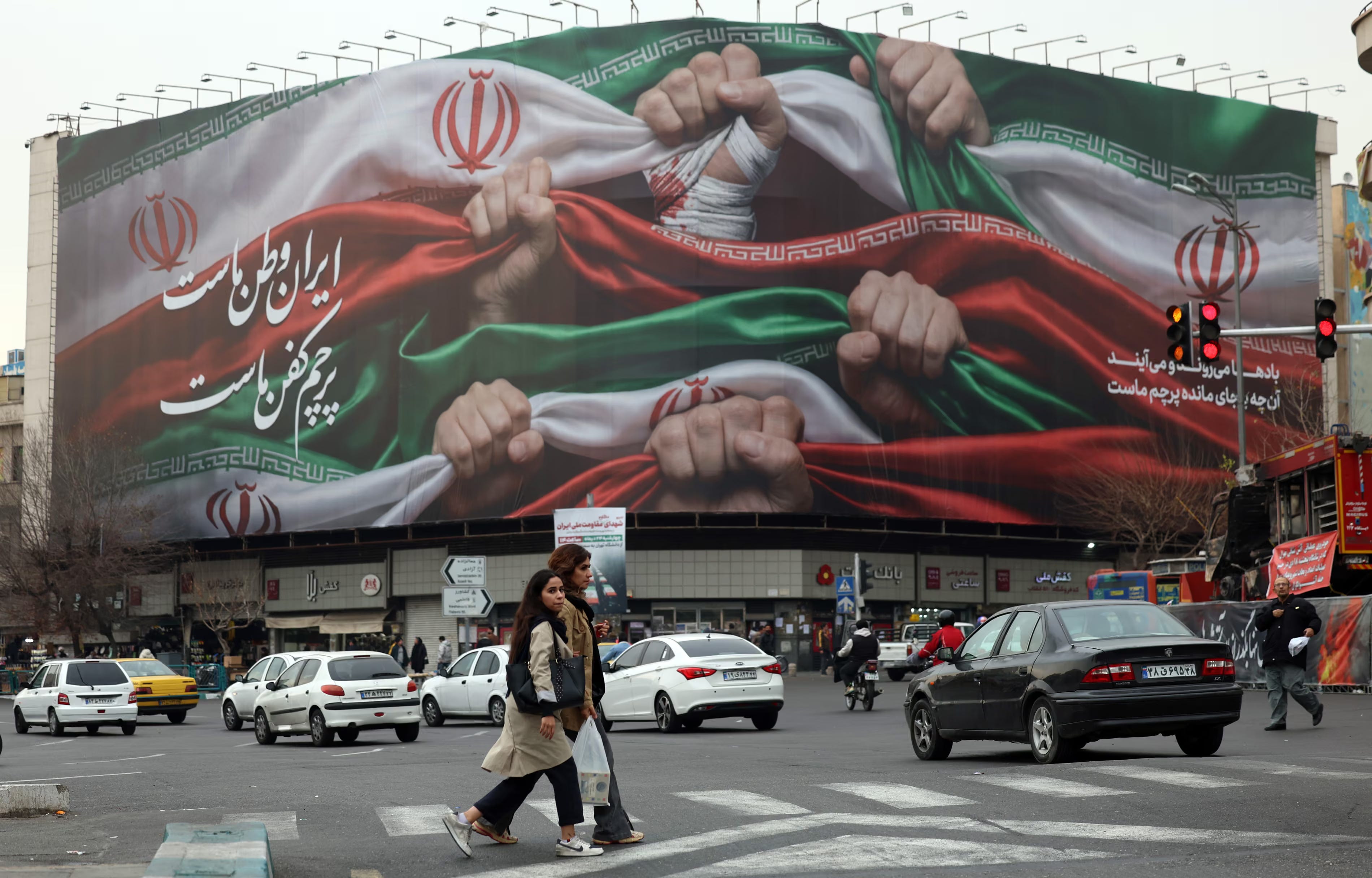
Something bad has happened in Iran. Around the start of the year, millions of people came out into the streets demanding an end to the Islamic Republic. For a moment everyone outside the country started acting as if the mullahs were about to actually lose their grip on power: any day now, any moment, the Iranian people will shrug off the theocrats like a veil and turn into a nice liberal democracy. It didn’t happen. Khamenei is still in the Office of the Supreme Leader; the protesters are no longer in the streets. Something happened, which those of us outside the country might not be able to understand for a long time, but there are clues. Photos of body bags piled up in hospitals, shaky phone footage of blacked-out cities and constant automatic gunfire. They’ve been killing people; a lot of people.
Some of my comrades on the left have been discussing this in strangely familiar terms. No one likes seeing piles of body bags, sure, but you have to understand that there’s a wider context. This world is the site of a cosmic battle between good and evil, the American world-empire against the resistance, and the Islamic Republic is on the side of the resistance. For two years, Israel massacred the people of Gaza, and in all that time the only country in the world willing to take serious action against them was the Islamic Republic. Their enemies in the region are monsters: fat sybaritic oil sheikhs, gacked up jihadi headchoppers, al-Qaeda cadres in suits and ties, dead-eyed Zionist psychos, genocidaires of every stripe, cynics and fanatics, sex slavers, rapists. Meanwhile, what did the protesters want? Well, a lot of them wanted the Shah back. Reza Pahlavi, some dumb sixty-year-old rich kid who’s lived most of his life in the suburbs of Washington DC. Who celebrated when what is notionally his own country was bombed by Israel. The protesters want to abandon the Palestinians, all so they don’t have to wear a bit of cloth on their heads. They want to give up the struggle against evil for consumer goods and porn. So because of this, the Iranians are wrong to oppose a government that kills them.
They’re not entirely wrong. The failed revolution in Iran really was a battle between good and evil; the Islamic Republic really is on the side of good, and the protesters really are on the side of evil. If I’ve spent five thousand words muddying these terms around in history before limping to the present day, this is why. The Islamic Republic has staked all its legitimacy as a state on being on the side of good. It’s survived as one of only two non-Arab non-Sunni states in the Middle East by organising itself entirely in opposition to the other one. In most countries, foreign policy is an expression of domestic policy; in Iran it’s the other way round. That’s how it maintains the support of a big enough chunk of the population; this is why its legal code can define anti-government protest as waging war against God. But what does it actually mean for Iran to oppose the American world-empire? It means selling drones to Russia so they can murder random people in their apartments in Kiev. It means pointlessly impoverishing their own country. It means that millions of young Iranians now hate the Palestinians, truly hate them, would happily let Israel kill them all, because the indignity and unfreedom of the Islamic Republic has always been imposed on them as their pious duty to the suffering people of Palestine. The Islamic Republic has done what none of the secular states in the region ever could, and turn its people against Islam. By some measures, Iran is now the least religious state in the Middle East, with a smaller proportion of Muslims than Israel has non-Hiloni Jews. The protesters have been torching mosques.
The protesters wanted the freedom to do evil. But I’m starting to think that that’s simply what freedom is, the ability to do the wrong thing. Ibn Sina’s God can only ever do or be the best possible thing, so he’s a lifeless automaton. As human beings, we have the gift of ignorance and evil. We struggle through a world we do not understand, and every choice we make is wrong. We’re lucky enough to live surrounded by a gorgeous variety of imperfect forms, and not the monotony of the good. Every vision of the purely and eternally good ends up summoning some kind of brain-melting horror. If it’s not the corpse-god it’s a cosmic torturer, or a god that personally devours the flesh of starving children. Strangely, though, our normal everyday finitude does not. I think this goes for political freedom as much as metaphysical freedom. Freedom is the freedom to be evil, to do and say bad things instead of good ones. If you choose evil, a few good things might happen, but only sparingly, and by accident. If you choose good, though, they absolutely never will.
Not only these people. The idea keeps coming back, again and again. Bogomils, Cathars, Paulicians. The same idea, in an Islamic context, became the Druze religion; in Judaism it’s Lurianic Kabbalah. And, more than a lot of people want to admit, the early phases of what would become orthodox Christianity belong in this current too. There’s a reason half the parables in the Gospels encode essentially the same message as the Ahunavaiti Gatha, and why Matthew insists that the birth of Jesus was attended by a gaggle of Iranian fire-wizards.